If you live in the centre of Cádiz, near bars on La Caleta, on a busy avenue or facing the sea during a Levante wind, you know what we mean: noise is a constant companion that affects sleep, concentration and quality of life. Older Cádiz homes, with aluminium windows without thermal break and worn-out shutters, let sound through as if they weren't there.
The good news is that soundproofing a home in Cádiz is perfectly achievable without a full renovation. Windows are responsible for 60–70% of noise entering a home, so replacing them is by far the most effective measure. But there are other things you can do. In this guide we explain them all, ranked from highest to lowest impact.
Main noise sources in Cádiz
Before discussing solutions, it helps to understand where the noise comes from in each part of Cádiz, because not all sources are tackled the same way. A low-frequency continuous noise like traffic on the Avenida requires a different treatment from the high-pitched intermittent noise of nightlife in La Viña.
- Road traffic on the Avenida and Extramuros: continuous low-frequency noise (60–500 Hz) from engines and tyre roll. Typical levels of 65–75 dB at facade level. Requires acoustic mass: thick laminated glass and profiles with good airtightness.
- Port activity (Puerto–Santa María del Mar area): intermittent industrial noise, ship horns, loading and unloading. Can reach peaks of 80 dB, especially during morning hours.
- Nightlife in La Viña and El Pópulo: voices, music and terraces until the early hours. Mid-to-high frequencies (500–4,000 Hz) that easily penetrate through gaps and poorly sealed shutter boxes.
- Levante wind: on strong Levante days (gusts of 60–80 km/h), poorly sealed windows rattle and whistle. It is not just a noise problem: it also causes sand and dust infiltration.
- Noise between dwellings: in older buildings in Santa María and El Pópulo, thin partition walls and timber floor joists easily transmit footsteps, conversations and neighbours' music.
1. Replace the windows: the most effective measure
An old aluminium window without thermal break and single glass provides just 20–25 dB of acoustic insulation. A new PVC or thermal break aluminium window with acoustic double glazing (laminated glass 6+6/16/4) achieves 38–42 dB. That is the difference between clearly hearing a conversation in the street and barely perceiving a murmur.
Soundproofing, from highest to lowest impact
- 1Replace the windowsResponsible for 60-70% of noise: acoustic double glazing rises from 20-25 dB to 38-42 dB.
- 2Shutters with an insulated boxThe old box leaks noise; an insulated one improves that window by 5-8 dB.
- 3Terrace enclosureCreates a double acoustic barrier and cuts 15-20 dB in the terrace area.
- 4Entrance and terrace doorsA solid door with weatherstripping and a bottom seal: 10-15 dB less from the landing.
- 5Acoustic wall dry-liningPlasterboard with mineral wool on party walls: a 10-22 dB improvement.
- 6Acoustic false ceilingA decoupled framework with mineral wool: cuts 15-20 dB of impact noise.
Acoustic laminated glass is the key: made from two glass panes bonded together with an acoustic PVB interlayer, it dampens sound vibrations far better than a monolithic pane of the same thickness. For homes in noisy areas of Cádiz, we recommend a minimum configuration of 6+6/16/4 (two laminated panes 6+6, 16 mm argon cavity, and 4 mm inner pane).
Window types by acoustic insulation level
| Window type | Glass configuration | Insulation (Rw) | Price per window (1.2 x 1.2 m) |
|---|---|---|---|
| Aluminium without TB + single glass | 4 mm monolithic | 20–25 dB | (existing) |
| TB aluminium + standard double | 4/16/4 | 28–32 dB | €350–500 |
| PVC / TB aluminium + acoustic double | 6+6/16 argon/4 | 38–42 dB | €450–650 |
| PVC / TB aluminium + reinforced acoustic double | 6+6/20 argon/6+6 | 42–45 dB | €550–800 |
| Acoustic triple glazing | 6+6/14/4/14/6 | 45–48 dB | €700–1,000 |
For most homes in Cádiz, the acoustic double glazing configuration (38–42 dB) is sufficient. We only recommend acoustic triple or reinforced double for facades directly facing the Avenida, concentrated nightlife areas or the port.
2. Shutters with insulated box
The shutter box is one of the biggest sources of noise leakage in a home, and is often overlooked. Old boxes are simple masonry enclosures with no insulation, with gaps that let in air, noise and dust. Replacing the shutters with new ones with a thermally insulated box can improve that window's acoustic insulation by an additional 5–8 dB.
3. Terrace enclosures
If your terrace faces a noisy street, enclosing it with a fixed thermal break aluminium or PVC enclosure with double glazing creates a double acoustic barrier: the noise has to pass through the enclosure first and then the interior windows. The result can be a reduction of 15–20 dB in the terrace area, turning a terrace unusable due to noise into a peaceful space.
Want to soundproof your home in Cádiz? Request a no-obligation quote. We assess your situation and propose the most effective solution for your budget.
4. Entrance and terrace doors
Doors are the other acoustic weak point. A solid entrance door with perimeter weatherstripping and a bottom seal can improve insulation between the landing and your flat by 10–15 dB. Terrace doors in thermal break aluminium with acoustic double glazing perform the same as windows for sound insulation.
5. Wall soundproofing
When the noise comes from a neighbour or an adjacent commercial premises, windows are not the answer: you need to work on the party walls. In old-town buildings in Cádiz (El Pópulo, Santa María), partition walls between dwellings are usually single hollow brick of 4–7 cm, providing barely 30–35 dB of acoustic insulation. To reach the 50 dB recommended by the CTE, the most common solution is a dry-lining of plasterboard with mineral wool inside.
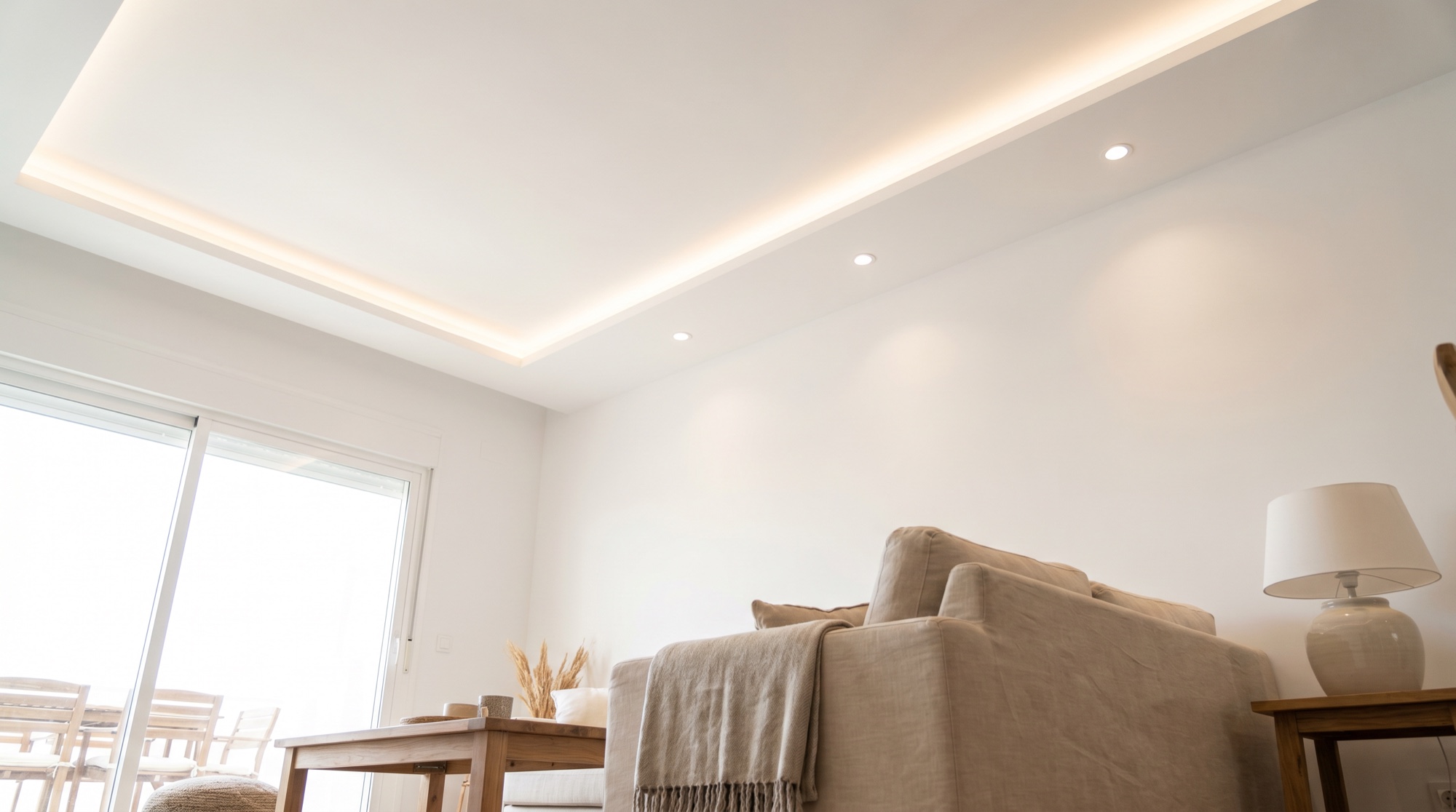
- Single dry-lining (1 board + 40 mm mineral wool): 10–12 dB improvement. Cost: €35–50/m². Takes up 6–7 cm of space.
- Double dry-lining (2 boards + 60 mm mineral wool): 15–18 dB improvement. Cost: €50–70/m². Takes up 8–10 cm of space.
- Dry-lining with special acoustic board (such as Placo Phonique): 18–22 dB improvement. Cost: €60–85/m². Thinner than the standard double.
6. Ceiling soundproofing
Footsteps, furniture dragging and music from the upstairs neighbour are transmitted through the floor slab. In flats with timber floor joists (common in the historic centre of Cádiz) the problem is especially acute. The solution is an acoustic false ceiling: an independent metal framework with anti-vibration hangers, high-density mineral wool and one or two plasterboard layers. The cost is €45–65/m² installed and it reduces impact noise by 15–20 dB. It is important that the false ceiling structure does not directly touch the old floor slab, as any acoustic bridge negates part of the improvement.
dB reduction by solution type and cost
| Solution | Typical reduction | Indicative cost | Best against |
|---|---|---|---|
| Acoustic double window (6+6/16/4) | 15–20 dB | €450–650/window | Traffic, street voices |
| Insulated shutter box | 5–8 dB | €200–500/unit | General airborne noise |
| Acoustic wall dry-lining | 10–22 dB | €35–85/m² | Neighbour noise, commercial premises |
| Acoustic false ceiling | 15–20 dB | €45–65/m² | Footsteps, impact from above |
| Terrace enclosure | 15–20 dB | €4,000–9,000 | Outdoor noise in terrace area |
| Acoustic entrance door | 10–15 dB | €600–1,500/unit | Landing and stairwell noise |
Summary: investment by insulation level
| Measure | Acoustic improvement | Indicative cost |
|---|---|---|
| Window replacement (6 units) | +15–20 dB | €2,800–5,800 |
| Shutters with insulated box (6 units) | +5–8 dB | €1,200–3,000 |
| Terrace enclosure | +15–20 dB (terrace area) | €4,000–9,000 |
| Reinforced entrance door | +10–15 dB | €600–1,500 |
Factors that affect soundproofing costs in Cádiz
- Condition of existing openings: if the masonry frames are deteriorated or out of square (very common in flats in El Pópulo and La Viña), the sub-frame needs rebuilding, adding €80–150 per window.
- Building access: in narrow streets of the old town, carrying materials by hand or with a small crane increases installation costs by 10–15%. In Bahía Blanca or Extramuros, with vehicle access, the cost is standard.
- Heritage protection: in listed buildings in El Pópulo, the council may require that new windows maintain the original external appearance (slim profiles, specific colours). This limits options to aluminium lacquered in specific colours, which can add 15–20% to the price.
- Humidity and salt air: on sea-facing facades or ground floors in neighbourhoods like Santa María, humidity and salt degrade weatherseals faster. It is worth choosing quality EPDM seals and profiles with Qualicoat Seaside treatment to maximise durability.
Common mistakes when soundproofing in Cádiz
- Replacing the windows but not the shutter box: the old box can leak 8–10 dB of noise, negating much of the improvement from the new window. It is like closing the door but leaving the window open.
- Choosing standard double glass (4/16/4) instead of acoustic (6+6/16/4): the standard double only provides 28–32 dB. For noisy areas in Cádiz, it falls short. The price difference is just €30–50 per window.
- Forgetting door seals: a poorly sealed terrace door leaks as much noise as an old window. Fitting perimeter EPDM weatherstripping costs €20–40 and the difference is immediate.
- Insulating only one wall without the ceiling: sound takes the easiest path. If you insulate the party wall but the floor slab still transmits, the noise goes around the barrier.
The priority order is clear: windows first (greatest impact per euro), then shutters, and finally enclosures and doors. If your budget is limited, start with the bedroom windows, that is where the difference is most noticeable.