How Much Does It Cost to Replace Roller Shutters in Cádiz? Prices & Types 2026
Roller shutters are one of those home elements you don't appreciate until they fail. In Cádiz, where the sun beats down for eight months of the year and the Levante wind batters the facades, worn-out shutters mean lost insulation, annoying noise when raising and lowering, and unnecessary air conditioning costs. Replacing them is an investment you notice from day one.
In this guide we explain how much it costs to replace the shutters in a flat in Cádiz, what materials are available and when motorisation is worthwhile. All with real 2026 prices based on installations we have carried out in Cádiz city, San Fernando, Chiclana and the Bay.
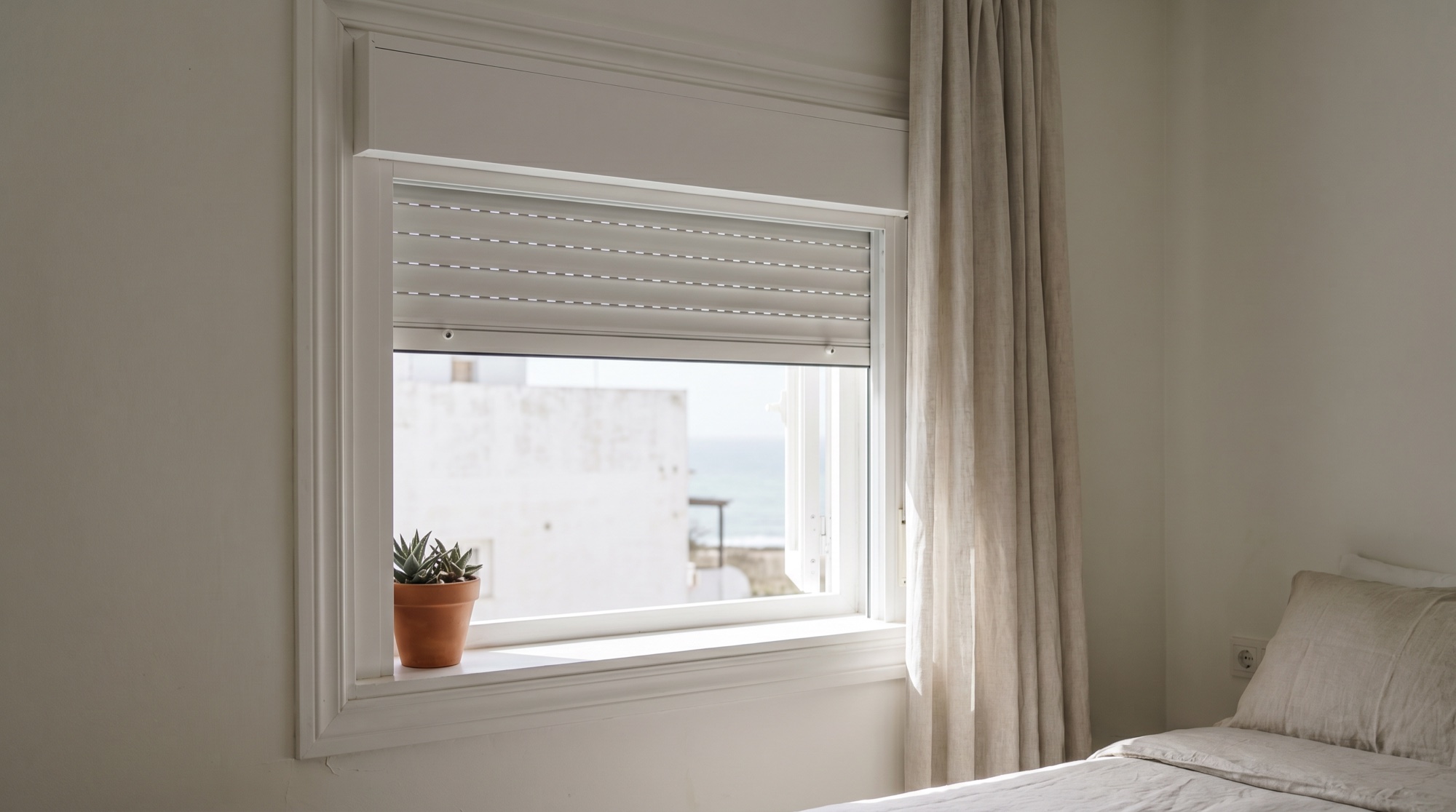
Types of shutters: PVC, aluminium and motorisation
Roller shutters are manufactured in two main materials: PVC and aluminium. PVC is the most affordable and offers good thermal insulation thanks to its hollow slats with air chambers. It is the standard choice in most Cádiz homes and performs well under normal conditions. However, low-quality PVC slats can warp in intense heat (south-facing surfaces in peak August) and are less impact-resistant.
Polyurethane foam-injected aluminium is the premium alternative. The slats are stronger, lighter and insulate better than entry-level PVC. They are the recommended choice for ground floors (greater security against intrusion), beachfront properties (salt resistance) and large windows where the weight of PVC strains the mechanism.
Motorisation is the third deciding factor. A motorised shutter eliminates the strap or crank handle, operates via a wall switch or remote control, and can be integrated with home automation. In flats with many windows the convenience is enormous, especially for elderly people or those with limited mobility. The additional cost per window (€150–250) is quickly recouped in comfort.
Shutter prices in Cádiz (2026)
| Type | Price per window | Full flat (6 windows) | Includes |
|---|---|---|---|
| Manual PVC (strap) | €150–250 | €900–1,500 | Slats, box, guides, collector, installation |
| Foam-injected aluminium manual | €250–380 | €1,500–2,280 | Aluminium slats, box, guides, installation |
| Motorised PVC | €300–420 | €1,800–2,520 | PVC slats, tubular motor, switch, installation |
| Motorised aluminium | €400–650 | €2,400–3,900 | Aluminium slats, motor, remote, installation |
Prices are for standard-sized windows (1.0–1.5 m wide). Larger windows or balcony doors may cost 20–40% more. Installation includes removal of the old shutter and cleaning of the box. If the box is damaged or too small for the new slats, replacing it adds €80–150 per window.
Detailed material comparison: PVC vs aluminium vs wood
| Feature | PVC | Foam-injected aluminium | Wood |
|---|---|---|---|
| Price per window (installed) | €150–250 | €250–380 | €350–550 |
| Salt air resistance | High (does not corrode) | Very high (resistant lacquer) | Low (requires frequent varnishing) |
| Thermal insulation | Good (air chambers in slats) | Very good (polyurethane foam) | Excellent (natural insulator) |
| Levante wind resistance | Medium (may bow in large openings) | High (rigid and lightweight) | High (heavy and solid) |
| Anti-intrusion security | Low | Medium-high | Medium |
| Maintenance | Minimal (clean with water) | Minimal (clean with water) | High (varnish every 2–3 years) |
| Durability in Cádiz | 15–20 years | 25–30 years | 10–15 years (without constant maintenance) |
Wood still exists as an option, mainly in listed buildings in the old town where heritage regulations require maintaining the original appearance. However, for the vast majority of homes in Cádiz, PVC or aluminium are far superior options in terms of durability and maintenance. Wood on the beachfront deteriorates quickly due to salt air and humidity, and requires varnishing every 2–3 years to stay in condition.
Motorisation costs: detailed breakdown
| Component | Price | Notes |
|---|---|---|
| Basic tubular motor (10–20 Nm) | €80–120 | Sufficient for standard windows up to 1.5 m wide |
| Heavy-duty tubular motor (30–50 Nm) | €120–180 | Required for balcony doors and large openings |
| Wall switch | €15–30 | Included in most quotes |
| Remote control (1 channel) | €25–40 | Controls a single shutter |
| Centralised remote (multi-channel) | €60–120 | Controls all shutters in the flat from one remote |
| Sun/wind sensor | €80–150 | Raises or lowers shutters automatically based on weather conditions |
| Electrical installation (per window) | €40–80 | Wiring from consumer unit to shutter box. Included if electrical renovation is underway |
The total cost of motorising an existing shutter in good condition is around €200–300 per window. If the slats are replaced at the same time as motorisation, the labour saving is significant because the same dismantling is reused. For a full flat of 6 windows, motorising everything at once works out 10–15% cheaper than doing it window by window.
Levante wind resistance: why it matters in Cádiz
The Levante wind is a reality that shapes many construction decisions in the province of Cádiz. With gusts that can exceed 80 km/h and consecutive days of sustained wind, shutters take significant mechanical punishment. Low-quality PVC slats bow, guides misalign and strap mechanisms wear out much faster.
- On east-facing facades (the most exposed to the Levante), we recommend foam-injected aluminium slats or reinforced PVC with a central rib. Standard thin PVC slats tend to bow in strong wind.
- Guides must have sufficient depth (at least 20 mm of travel) so that slats don't come out with wind vibrations. In many old Cádiz flats, the original guides are too shallow.
- Motorised shutters withstand wind better than manual ones because the motor maintains barrel tension, preventing slats from vibrating and banging.
- In very exposed locations, such as facades with no buildings opposite in Bahia Blanca or on the beachfront, consider high-strength extruded aluminium slats.
Need to replace the shutters in your flat in Cádiz? Request a no-obligation quote. We install throughout the Bay of Cádiz.
Durability against salt air: how the coastal climate affects shutters
Salt air is the other great enemy of shutters in Cádiz. The sea breeze deposits salt particles on exterior surfaces, and if the materials are not designed for it, corrosion appears within a few years. Here is what you need to know about each material:
- PVC: immune to salt air. It does not corrode, does not rust and needs no protective treatment. This is the main advantage of PVC in a coastal environment.
- Lacquered aluminium: resists salt air very well if the lacquer is quality (Qualicoat class 2 or Seaside). With cheap lacquers, salt can cause bubbling and peeling within 5–8 years.
- Metal components (barrels, springs, screws): must be galvanised or stainless steel. In many cheap shutters, untreated steel springs are the first thing to fail in a salt-laden environment.
- Strap collectors: plastic ones hold up well. Chrome-plated metal ones corrode quickly. Make sure collectors are PVC or aluminium.
Thermal insulation: how much you can save with new shutters
Shutters are an undervalued thermal barrier. A closed shutter can reduce heat loss through the window by up to 40% in winter and block up to 90% of direct solar radiation in summer. In Cádiz, where air conditioning runs from May to October, shutters in good condition can mean savings of €150–300 per year on the electricity bill of an average flat.
- Foam-injected aluminium slats have the best thermal insulation (U-coefficient of 3.5–4.0 W/m2K with the shutter closed).
- PVC slats with air chambers insulate well but slightly less than foam-injected aluminium (U of 4.0–5.0 W/m2K).
- The shutter box is a critical point of heat loss. An uninsulated box can account for up to 30% of the window's thermal losses. Insulating the box with extruded polystyrene boards is a cheap upgrade (€15–25 per box) with a noticeable impact.
When is it worth motorising your shutters?
- If you have more than 5 windows: the convenience of operating them all with one remote justifies the investment.
- If there are elderly people or those with limited mobility at home: straps and crank handles require force and repetition that can be problematic.
- If you are renovating and already have electricians on site: the motor wiring is integrated into the project at no extra electrical labour cost.
- If you want to schedule times: motorised shutters with a timer can raise and lower automatically, simulating occupancy when you are on holiday.
Tip: if you are replacing both windows and shutters at the same time, the saving on labour and installation can be 15–20% compared with doing it in two phases.
Common problems with old shutters in Cádiz
Flats built between the 1960s and 1990s in Cádiz, both in Extramuros and in central neighbourhoods, typically have original shutters that have already exceeded their useful life. These are the most common problems we find when renovating:
- Uninsulated boxes: the original built-in boxes are simple cavities in the wall with no insulation whatsoever. They are a constant source of draughts, noise and heat loss.
- Rusted barrels: the metal barrel on which the shutter rolls up rusts in salt air, especially in flats near the sea. A rusted barrel makes movement difficult and eventually breaks the strap.
- Misaligned or overly narrow guides: over the years, building movement and traffic vibrations misalign the guides, causing the shutter to jam or not lower fully.
- Sun-warped slats: original low-quality PVC slats, exposed to decades of Cádiz sun, warp and leave gaps between them through which light and heat enter.
- Worn straps: nylon straps degrade with UV light. On south and east facades in Cádiz, a medium-quality strap lasts 5–7 years; a cheap one, barely 2–3.
Signs that you need to replace your shutters
- The strap breaks or frays frequently.
- The shutter gets stuck halfway or won't lower completely.
- The slats are warped, broken or have visible gaps between them.
- You notice drafts or cold coming through the shutter box.
- The noise when raising and lowering is excessive (squeaking, banging).
Installation process and timelines
Shutter replacement is a relatively quick and clean job. Here is the typical process and the timelines we work with:
- Survey visit (30–45 minutes): we measure each window, check the condition of the box and guides, and advise on material and motorisation.
- Manufacture (7–12 working days): slats are cut to exact measurements. For very standard sizes, the lead time can be reduced to 5 days.
- Installation (45–60 minutes per manual window, 60–90 minutes per motorised window): removal of the old shutter, cleaning of the box, fitting of new slats, guide adjustment and function test.
- A full flat of 6 manual windows is installed in one day. With motorisation and new wiring, the timeline is 1–2 working days.