PVC vs Aluminium Windows: Which Is Better for Your Renovation in Cádiz?
If you're thinking about replacing your windows in Cádiz, you've probably already run into the big question: PVC or aluminium, which is better? There's no single answer, because it depends on your home, your budget, and what matters most to you. What we can do is give you the full picture, real prices, technical data, and our hands-on experience of renovations across the province of Cádiz, so you can make your decision with complete confidence. In this guide we break down every factor that counts, with no waffle and no unnecessary jargon.
What's the difference between PVC and aluminium windows?
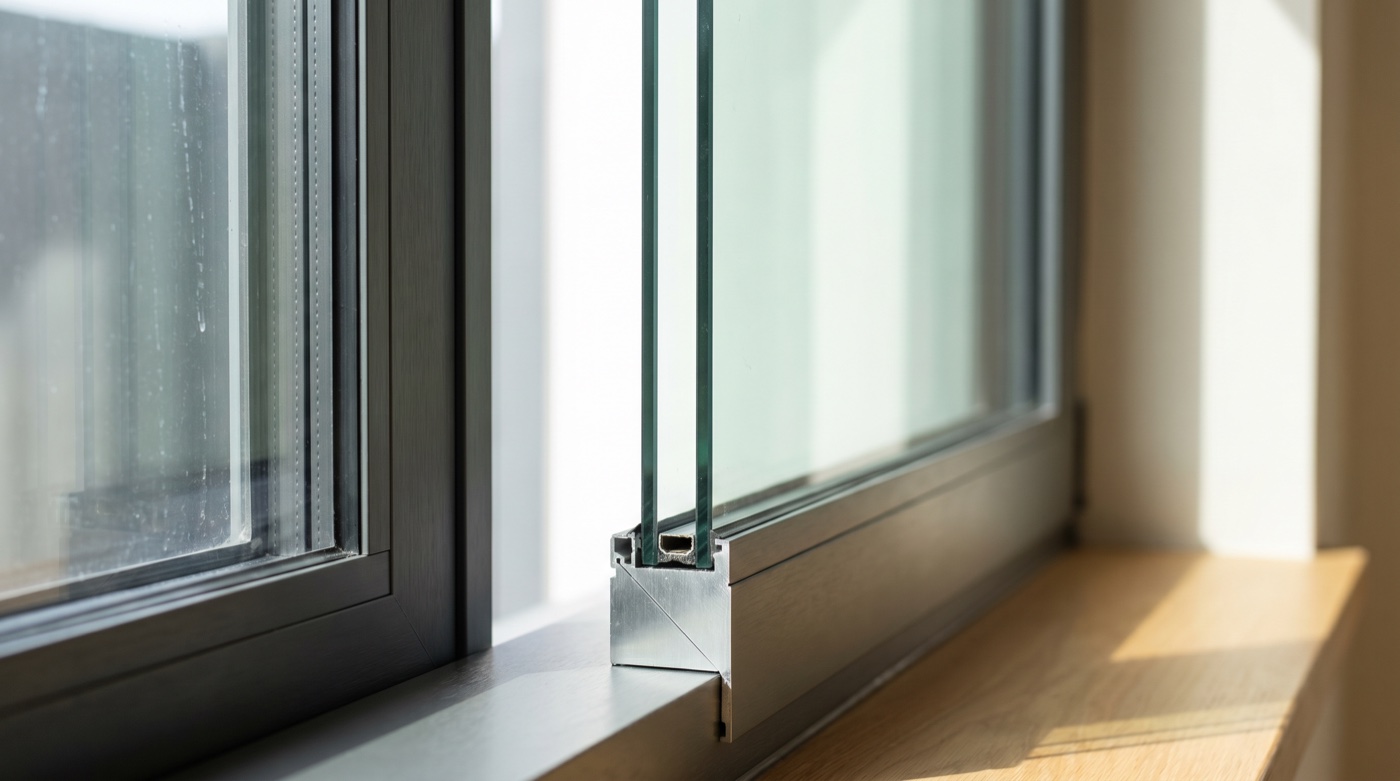
PVC windows (polyvinyl chloride) are made from rigid plastic profiles with internal air chambers. These chambers act as a natural barrier against heat and cold, which makes PVC an inherently good thermal insulator. The material doesn't conduct temperature easily, which is why it became so popular across Europe from the 1990s onwards.
Aluminium, on the other hand, is a lightweight and extremely strong metal. Its historical weakness has been thermal conductivity: it transfers heat and cold readily. To address this, manufacturers developed thermal break technology (TBT), which inserts a polyamide strip between the inner and outer faces of the aluminium frame. Thermal break aluminium windows in Cádiz are now the standard choice for new builds and quality renovations, and their performance is now very close to that of PVC.
In short: PVC insulates by virtue of the material itself; aluminium requires additional engineering (thermal break) to achieve comparable insulation. Both can be fitted with double or triple glazing, high-security hardware, and custom finishes. The real difference lies in the frame, not the glass.
PVC vs. aluminium at a glance
PVC
- Insulates naturally (U 1.0-1.3)
- 20-30% cheaper
- 25-35 year lifespan
- Slightly bulkier frames
Thermal-break aluminium
- Needs a thermal break
- Slim frames, more glass
- 40-50 year lifespan
- Best on the seafront
Thermal and acoustic insulation: which material wins in Cádiz?
Cádiz has a very particular climate: long summers with temperatures regularly exceeding 35 °C, a persistent Levante wind, and relative humidity that hovers around 70–80% for much of the year. In these conditions, window insulation is not a luxury, it has a direct impact on your energy bills. A poorly insulated window can account for up to 30% of a home's energy losses, according to figures from the IDAE.
In terms of thermal transmittance (U-value), a mid-range quality PVC profile achieves values of 1.0–1.3 W/m²K. A mid-range thermal break aluminium profile sits between 1.4–2.0 W/m²K. The gap exists, but it has narrowed considerably in recent years. If you compare a high-end PVC (such as Kömmerling or VEKA 5-chamber) with a high-end thermal break aluminium (such as Cortizo COR 80 or Schüco), the difference is minimal: just 0.2–0.3 W/m²K.
When it comes to acoustic insulation, both materials deliver similar results when paired with appropriate glazing. For a flat in the centre of Cádiz city or in busy tourist areas such as La Caleta or Playa de la Victoria, we recommend cavity glazing with a 16–20 mm gap and at least one acoustic laminated pane (6+6/16/4 configuration). With this setup, both PVC and thermal break aluminium can reduce external noise by between 35 and 42 dB, enough to turn a noisy street into a distant murmur.
Practical tip: if your home faces south or south-west, very common in Cádiz city, Chiclana, or El Puerto de Santa María, prioritise the U-value of the whole unit (frame plus glass) rather than the profile alone. A good low-emissivity solar control glass can make more of a difference than the choice between PVC and aluminium.
Durability and maintenance: PVC vs aluminium in a coastal climate
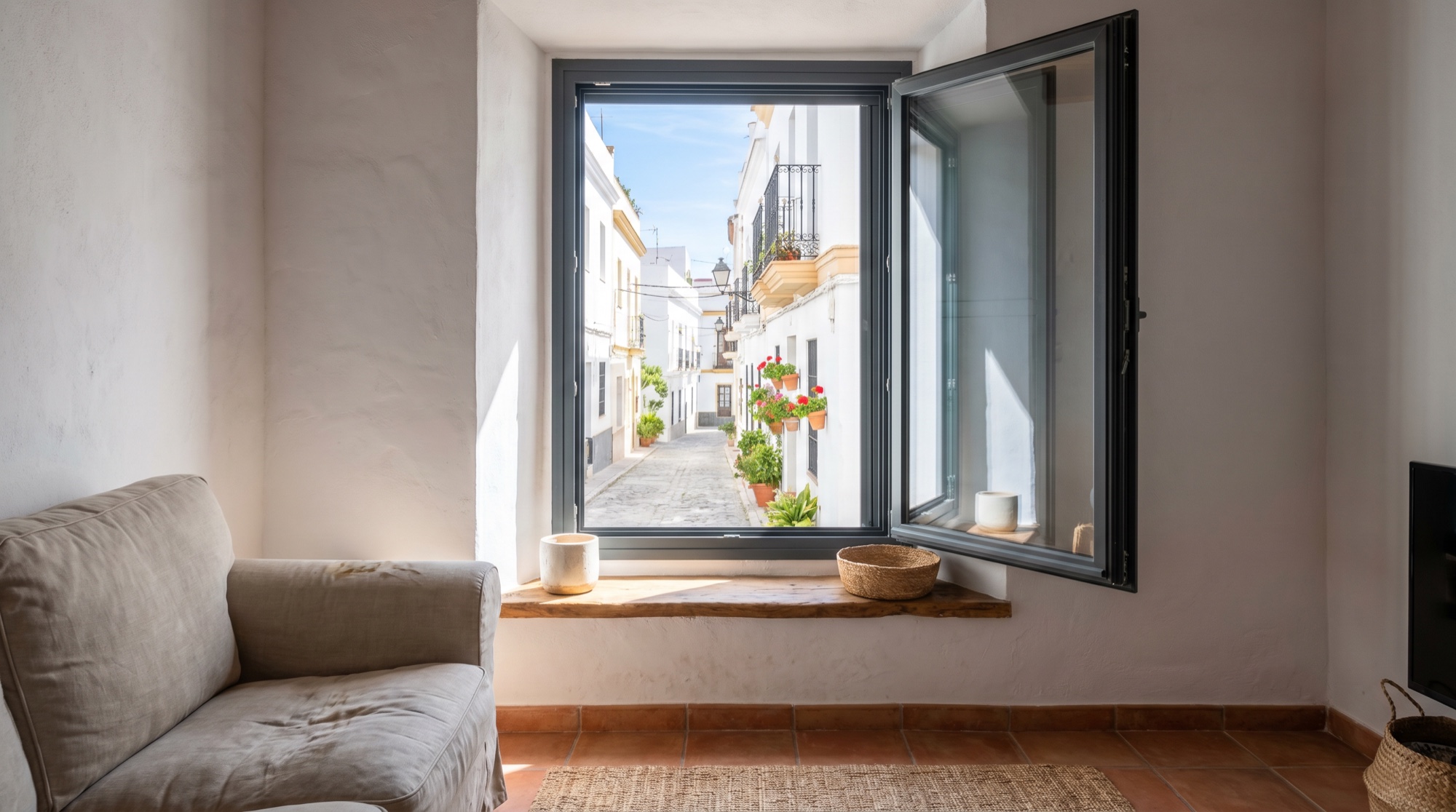
Living near the sea takes its toll on your home's materials, and windows are no exception. The salt-laden breeze, constant humidity, and intense sun that Cádiz is known for put any exterior joinery through its paces. In this respect, both PVC and aluminium have clear advantages over timber, but they behave quite differently from each other.
PVC doesn't rust, doesn't corrode, and requires no painting. Maintenance amounts to wiping the profiles down with water and mild soap a couple of times a year. However, cheap white PVC profiles can yellow with intense sun exposure after 10–15 years. High-end manufacturers incorporate anti-UV additives and stabilisers that extend the colour's lifespan to 25–30 years without issues. The key is not to cut corners on profile quality.
Aluminium is extraordinarily resistant to corrosion when it has a proper lacquer finish (polyester powder or PVDF coating). In coastal areas such as Cádiz, Rota, or Sanlúcar de Barrameda, we always recommend finishes with Qualicoat Seaside certification, which are specifically designed to withstand salt. With this treatment, aluminium can last 40–50 years without visible deterioration. That said, if the lacquer is damaged or a basic finish is chosen, corrosion can appear within 5–8 years on the seafront.
- PVC: service life of 25–35 years. Minimal maintenance (water and mild soap). Risk of yellowing with cheaper profiles in direct sunlight.
- Aluminium with thermal break and Qualicoat finish: service life of 40–50 years. Minimal maintenance. Requires a certified quality finish in coastal areas.
- Both materials: check the hardware and weatherseals every 3–5 years. Salt air can affect locking mechanisms before it affects the profiles themselves.
PVC or aluminium for your windows? Request a free quote and we'll advise based on your home in Cádiz.
PVC vs aluminium window prices in Cádiz (2026)
Cost is, naturally, one of the deciding factors. Below are indicative prices updated to 2026 for the province of Cádiz, including installation and removal of the old windows. Bear in mind that the final cost depends on size, opening type, glazing, and the finishes you choose.
| Item | PVC (mid-to-high range) | Thermal break aluminium (mid-to-high range) |
|---|---|---|
| Sliding window 1.5 x 1.2 m (2 panes) | €420 – €580 | €530 – €720 |
| Tilt-and-turn window 1.0 x 1.2 m (1 pane) | €350 – €480 | €450 – €620 |
| Balcony door 0.8 x 2.1 m | €480 – €650 | €600 – €820 |
| Fixed window 1.2 x 0.6 m | €180 – €260 | €220 – €320 |
| Motorised blind (add-on) | €250 – €400 | €250 – €400 |
| Installation per window (included in prices above) | Included | Included |
As you can see, thermal break aluminium typically costs 20–30% more than PVC for equivalent performance. For a full window replacement in a three-bedroom flat in Cádiz (covering 5–7 windows and 1–2 balcony doors) the total difference can range between €800 and €1,500 depending on dimensions. The price for a PVC window project of this scale in Cádiz in 2026 typically falls between €2,800 and €4,500, while thermal break aluminium runs from €3,600 to €5,800.
One important point: these figures apply to energy-efficient windows in Cádiz with low-emissivity double glazing and quality hardware. If you receive quotes well below these ranges, ask exactly which profile, glass, and hardware are included. In our experience, saving €100 per window on cheaper materials can easily cost you €300 a year in heating and cooling. We work with brands including Kömmerling, Rehau, and Deceuninck for PVC, and Cortizo, Technal, and Schüco for aluminium, always ensuring the best value for money.
Aesthetics and design options: which looks better in your home?
A few years ago, choosing PVC meant making peace with white frames and a slightly bulky look. That's changed dramatically. Today, PVC profiles are available in more than 30 colours and foil finishes that mimic oak, walnut, anthracite, or even metallic tones. The frames are still slightly wider than aluminium ones (between 5 and 15 mm more on each side), but the lines have become considerably sleeker in the latest generations of profiles.
Aluminium, meanwhile, remains the undisputed choice for minimalist aesthetics. It allows for slimmer frames, which maximises the glazed area and gives a sense of lightness that is highly prized in contemporary architecture. Lacquered finishes offer a virtually limitless RAL colour palette, with matt, satin, or textured options. For homes with clean, modern lines in developments such as Novo Sancti Petri, Sotogrande, or Zahara de los Atunes, aluminium is usually the preferred aesthetic choice.
If your renovation is in a building within Cádiz's historic old town, bear in mind that planning regulations may specify particular colours and finishes for external joinery. Both foil-wrapped PVC and lacquered aluminium can meet these requirements, but it's worth checking before you decide. We take care of verifying local planning rules as part of our renovation service.
When to choose PVC and when to choose aluminium
Once you've weighed up all the factors, the decision becomes much clearer if you ask yourself the right questions. It's not about which is better in the abstract, but which fits your specific situation better. Here's a summary of the most common scenarios we encounter in our renovation work across Cádiz.
Go for PVC if your priority is the best possible thermal insulation at the lowest cost, if your budget is tight and you want the best performance-to-price ratio, or if you live in an inland flat or one without direct sea exposure. It's also the most advisable option if you're looking for windows for a flat renovation in Cádiz city, in neighbourhoods such as Bahía Blanca, Loreto, Puntales, or La Segunda Aguada, where energy efficiency makes a real difference to your electricity bill.
Go for thermal break aluminium if your home is on the seafront or in an area with heavy salt exposure, if you value a minimalist aesthetic with slim frames, if you need large windows (aluminium handles the weight of large panes far better without warping), or if your budget allows you to invest in long-term durability. It's the preferred choice for detached houses, penthouses, and design-led homes throughout the Bay of Cádiz.
- City flat, tight budget, maximum insulation → mid-to-high range PVC.
- Coastal property, large windows, modern aesthetic → high-end thermal break aluminium.
- Full renovation with motorised blinds → both materials integrate perfectly; the cost of the blind is the same either way.
- Listed or historic building with aesthetic restrictions → check planning requirements and choose whichever material meets them at the best value for money.
Frequently asked questions about replacing windows in Cádiz
Here we've gathered the questions our clients in Cádiz most commonly ask when considering a window replacement. If you have a question that isn't covered here, give us a ring or drop us a message and we'll answer it with no obligation.