Built-in Wardrobes vs Freestanding Wardrobes: Which to Choose for Your Home in Cádiz
If you're renovating your home or simply need more storage, one of the most important decisions you'll face is choosing between a fitted wardrobe and a freestanding one. It's not purely an aesthetic question, it affects the usable space in your room, your budget, and the day-to-day practicality of your home. In Cádiz, where flats in the old town rarely exceed 70 square metres and the humidity takes its toll on any piece of furniture, this choice matters even more. This guide gives you everything you need to make an informed decision.
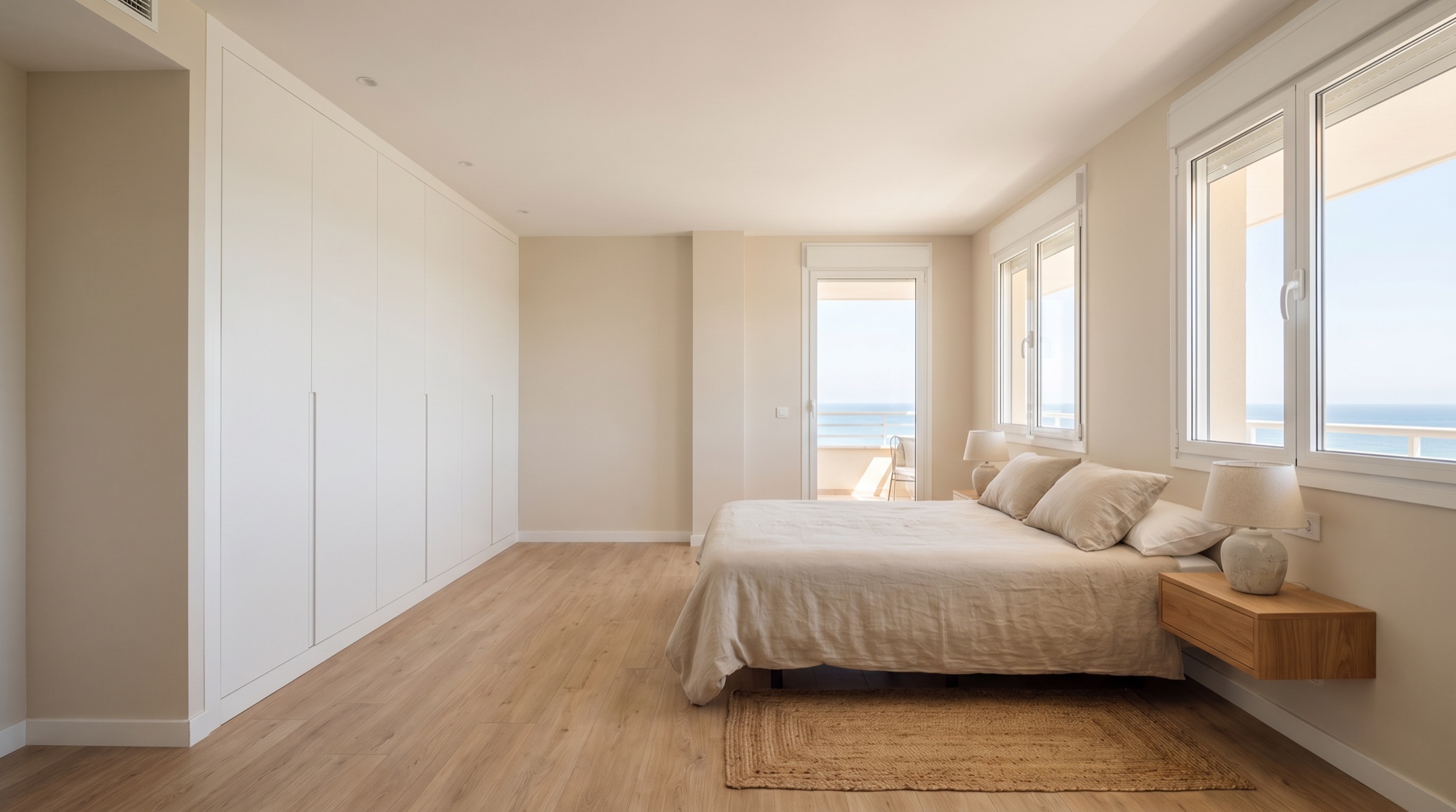
Key differences between fitted and freestanding wardrobes
A fitted wardrobe is built into the fabric of the property, constructed within a recess, alcove, or dedicated area of a room, using the existing walls, floor and ceiling as its sides, base and top. With no visible external frame, it blends seamlessly into the space and makes use of every last centimetre. A freestanding wardrobe, by contrast, is a self-contained piece of furniture with its own structure (sides, back panel, base and top) that stands against a wall and can be moved from room to room, or taken with you when you move house.
The fundamental difference isn't just about design, it's a question of philosophy. A fitted wardrobe is a permanent investment in the property: it adds value to your home but stays behind when you leave. A freestanding wardrobe is a moveable possession: you buy it, position it, and take it wherever you like. In the fitted versus freestanding debate, the right answer depends on your specific circumstances, the type of property you live in, and your plans for the medium term.
Built-in vs. freestanding at a glance
Fitted wardrobe
- Uses 100% of the recess
- Fully bespoke interior
- Adds value to the property
- Fixed, stays behind
Freestanding wardrobe
- Portable, take it with you
- Standard sizes, dead gaps
- No building work
- Lower upfront cost
| Feature | Fitted wardrobe | Freestanding wardrobe |
|---|---|---|
| Structure | Uses the property's walls as sides and back | Fully self-contained, independent structure |
| Space efficiency | Maximum: fills the entire recess from floor to ceiling | Limited: standard or near-standard dimensions only |
| Portability | Fixed in place, cannot be moved | Can be moved to another room or property |
| Customisation | Fully bespoke: dimensions, internal layout and finishes all made to measure | Variable: from off-the-shelf to partially customisable |
| Installation | Requires a professional joiner and minor building work | Straightforward assembly, often without a tradesperson |
| Adds value to property | Yes, regarded as a permanent improvement | No, considered personal furniture |
| Guide price (2 m wide) | €1,200 – €3,500 | €400 – €2,000 |
How much does a bespoke fitted wardrobe cost in Cádiz?
The price of a bespoke fitted wardrobe in Cádiz depends on three main factors: the dimensions of the space, the chosen material, and the complexity of the internal layout. A standard fitted wardrobe two metres wide by two and a half metres tall, with sliding melamine doors and a basic interior (a hanging rail, shelves and a drawer unit), typically comes in between €1,200 and €1,800 fully installed. If you opt for hinged lacquered doors and a more fully equipped interior, a trouser rack, tie rail, LED lighting and drawers with full-extension runners, the price moves into the €2,200 to €3,500 range.
For a fitted walk-in wardrobe in Cádiz, designed for master bedrooms with sufficient floor area, quotes generally start at around €3,000 and can exceed €6,000 depending on the size and finish. Lead times from the initial measuring visit through to installation typically run between three and six weeks, though during the busy renovation season (spring and early summer) it's worth allowing an extra week or two.
| Type of fitted wardrobe | Price range (installed) | Estimated lead time |
|---|---|---|
| Sliding melamine doors, basic interior | €1,200 – €1,800 | 3 – 4 weeks |
| Hinged lacquered doors, full interior | €2,200 – €3,500 | 4 – 5 weeks |
| Fitted walk-in wardrobe | €3,000 – €6,000+ | 5 – 6 weeks |
| Wardrobe front only (doors for an existing recess) | €600 – €1,400 | 2 – 3 weeks |
These prices reflect what joiners and wardrobe specialists charge in Cádiz city and the Bay area (San Fernando, Puerto Real, Chiclana). They include measuring up, manufacture, delivery and installation. VAT (21%) is typically quoted separately, so always check before you sign anything.
When to choose a fitted wardrobe: pros and cons
A fitted wardrobe is the clear winner when your priority is maximising storage without losing usable floor space. Built wall to wall and floor to ceiling, it eliminates the dead space that a conventional wardrobe leaves above and on either side. In the smaller flats found in Cádiz's historic centre, or in neighbourhoods such as La Viña, Santa María or Bahía Blanca where every centimetre counts, this advantage is decisive.
- Makes full use of the available recess, including the high ceilings typical of older properties
- Allows a completely bespoke internal layout tailored to your actual storage needs
- Sits flush with the room and creates a clean, cohesive finish
- Adds value to the property, buyers regard fitted wardrobes as a permanent improvement
- Better protection against dust and humidity when closed with a draught seal
The main drawback is that you can't take it with you if you move, it's an investment tied to the property. It also requires minor building work (at the very least to square off the recess, level the floor and prepare the walls), which means some dust, noise and a lead time to factor in. If you're renting on a short-term contract, a fitted wardrobe rarely makes financial sense unless the landlord gives permission and offers a reduction in rent to reflect the improvement.
When to choose a freestanding wardrobe: pros and cons
A freestanding wardrobe makes sense when flexibility is your priority. If you're renting, if you move frequently, or if you're not yet sure how you'll use a room in the long term, a standalone piece of furniture gives you the freedom to rearrange or take it with you. It's also a sound option as a temporary solution while you plan a more thorough renovation.
- Portable: move it to another room or property without any building work
- No professional installation required in most cases
- Immediately available if you choose standard off-the-shelf models
- Lower upfront cost, particularly for melamine or flat-pack ranges
- Lets you try out configurations before committing to a permanent fitted solution
The downsides of a freestanding wardrobe are essentially the flip side of the fitted wardrobe's strengths. It doesn't make the most of the available space, because standard dimensions, typically 60 cm deep, between 100 and 240 cm wide and up to 236 cm tall, rarely match the exact measurements of your room. Gaps appear above and on either side, which collect dust. In small bedrooms, a freestanding wardrobe can feel visually heavy and make the room seem smaller. And in terms of quality, budget flat-pack models tend to have a shorter lifespan than a well-made fitted wardrobe.
Built-in or freestanding? We'll design the ideal wardrobe for your space. Request a free quote.
Which type of wardrobe wins space in a small Cádiz flat?
In the most common type of property in Cádiz city, flats of between 50 and 80 square metres with bedrooms of around 8 to 12 square metres, the fitted wardrobe wins hands down. The advantages are plain to see: by spanning the full width of a wall and reaching the ceiling, it turns a space that would otherwise be wasted into genuine cubic metres of storage. A fitted wardrobe 2.50 m wide by 2.60 m tall and 60 cm deep provides approximately 3.9 cubic metres of storage, compared with the 2.8 to 3.0 cubic metres of a standard freestanding wardrobe at the same width.
Sliding doors also remove the need to leave clear floor space in front for the doors to swing open, in narrow bedrooms, this can free up between 50 and 70 centimetres. In many flats in the historic quarter with ceilings of three metres or more, the upper section of a fitted wardrobe becomes ideal storage for seasonal clothing, suitcases or duvets, space that a conventional freestanding wardrobe simply squanders.
Practical tip: if your bedroom is smaller than 10 square metres, always go for sliding doors on your fitted wardrobe. You'll reclaim between 50 and 70 cm of usable space compared with hinged doors, which can make the difference between fitting a bedside table in or not.
Materials and finishes: melamine, lacquer and solid wood
The choice of material determines the look, the durability and the price of your wardrobe. The three finishes most in demand for bespoke wardrobes in Cádiz are melamine, lacquer and solid wood, each suited to a different type of use.
Melamine is the most widely used material in Cádiz wardrobe joinery, thanks to its excellent value for money. It's a particle board coated with decorative paper impregnated with resin, available in a vast range of colours and finishes that mimic wood, stone or flat tones. It's resistant to abrasion and easy to wipe clean. Its weak point is sensitivity to moisture if the edges aren't properly sealed, something particularly important in a coastal area like Cádiz.
Lacquer gives a smooth, even and elegant finish that works particularly well with modern and minimalist interiors. Lacquered doors can be matt, satin or high-gloss, and are available in any RAL colour. The price is higher than melamine (typically 30 to 50% more) but the visual result is noticeably more refined. It does require a little more care when cleaning to avoid marking the surface.
Solid wood (pine, oak, chestnut) is the premium option for bespoke furniture in Cádiz. It brings warmth, character and exceptional longevity when properly finished, and ages beautifully. It's the most expensive of the three and requires a specific moisture-resistant treatment given the local climate. In properties with a rustic Andalusian character, or in the renovation of one of Cádiz's grand townhouses, solid wood is the natural choice.
| Material | Relative cost | Moisture resistance | Aesthetics | Maintenance |
|---|---|---|---|---|
| Melamine | Low – medium | Moderate (requires well-sealed edges) | Wide variety, wood-effect and plain finishes | Minimal: damp cloth |
| Lacquer | Medium – high (+30–50% vs melamine) | High (non-porous surface) | Elegant, smooth, any RAL colour | Moderate: avoid abrasives |
| Solid wood | High (+80–120% vs melamine) | Low untreated, high with appropriate varnish | Warm, characterful, ages well | High: re-varnish every 3–5 years |
How Cádiz's climate affects your wardrobe choice
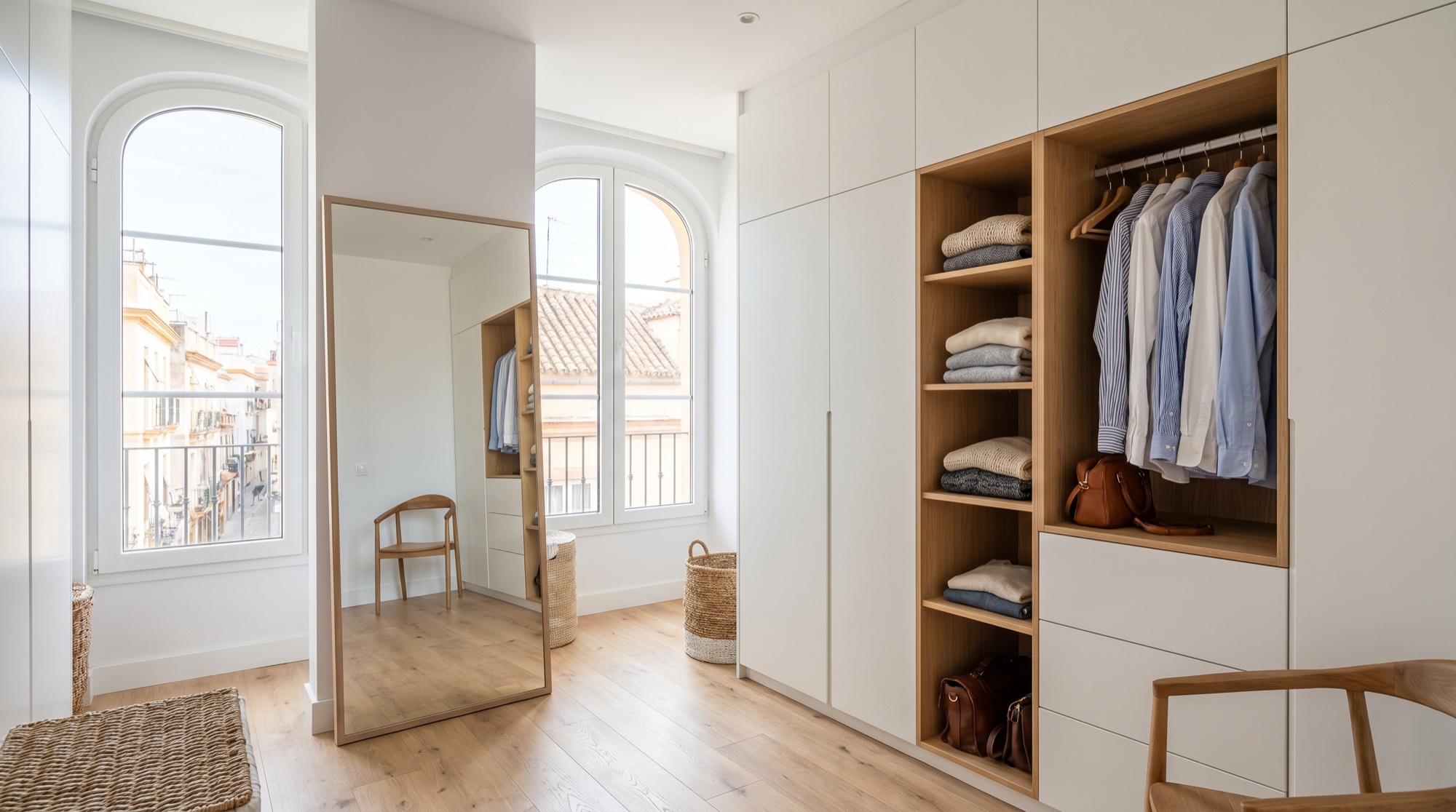
Cádiz has an average annual relative humidity of over 70%, with peaks above 80% in autumn and winter, particularly in areas close to the sea such as the Alameda, La Caleta or the La Viña neighbourhood. This persistent humidity is the silent enemy of any wood-based furniture. If you opt for a budget freestanding wardrobe made from untreated board, there's a fair chance that within two or three years you'll notice the base swelling, the doors warping, or mould appearing on the back panel, especially if the wardrobe is pushed up against an external wall.
A well-executed fitted wardrobe, built by an experienced Cádiz joiner, will include moisture-resistant measures that make a real difference: water-repellent treatment on the boards, discreet interior ventilation grilles, a gap between the back and any external-facing wall, and perimeter edge sealing. These details are what set a professional job apart from a generic installation. If your property is on the seafront or on the ground floor of the old town, always mention this to your joiner so they can strengthen these protections accordingly.
Watch out for damp: in Cádiz properties near the sea or on ground floors, always ask for moisture-resistant board (identifiable by its green-coloured edge) and interior ventilation in your fitted wardrobe. Placing silica gel sachets or a small rechargeable dehumidifier inside the wardrobe helps prevent mould from forming on your clothes, particularly during the levante wind season.
How to commission a bespoke wardrobe from a joiner in Cádiz
Commissioning a bespoke fitted wardrobe needn't be complicated if you follow a sensible process. Based on our experience working on full renovations and fitted wardrobe joinery in Cádiz, here are the steps we recommend to ensure the result is exactly what you're after.
- Define your actual storage needs: take stock of what you'll be storing (hanging clothes, folded clothes, shoes, bedding, suitcases) before designing the internal layout
- Choose your door type: sliding if space is tight, hinged if you prefer to see the full interior at a glance, or bi-fold as a middle ground
- Get at least three detailed quotes from local joiners, making sure each one covers materials, fittings, delivery, installation and VAT
- Ask for references and photos of previous work, ideally in properties similar to yours in Cádiz
- Confirm the delivery date in writing and agree a payment schedule (the standard is 40% on order, 40% on delivery of materials and 20% on completion)
- Check that the quote includes levelling adjustments for floor and walls, essential in older buildings where nothing is perfectly plumb or square
- Inspect the finished wardrobe before signing off: check that the doors open and close without catching, that drawers slide smoothly, and that there are no visible defects in the finish
At Reformas By Bianca we work with joiners who specialise in bespoke wardrobes in Cádiz, and we handle the entire process on your behalf, from the first measuring visit through to final handover with a warranty. If you'd like guidance on which type of wardrobe best suits your home, we're happy to help with no obligation.