How to Renovate a Small Bathroom in Cádiz: Step-by-Step Guide to Gain Space
If you live in Cádiz's old town, in a flat in San Fernando, or in a 1970s property in Chiclana, the chances are your bathroom is on the small side. That's no coincidence: most homes built across the province between the 1960s and 1990s set aside just 3 or 4 square metres for the bathroom. But a small bathroom doesn't have to be an uncomfortable one. With a well-planned renovation you can gain functionality, more light, and even the feeling that the space has doubled in size. In this guide we walk you through exactly how to renovate a small bathroom in Cádiz, with real figures, specific materials, and the prices we're working with in 2026.
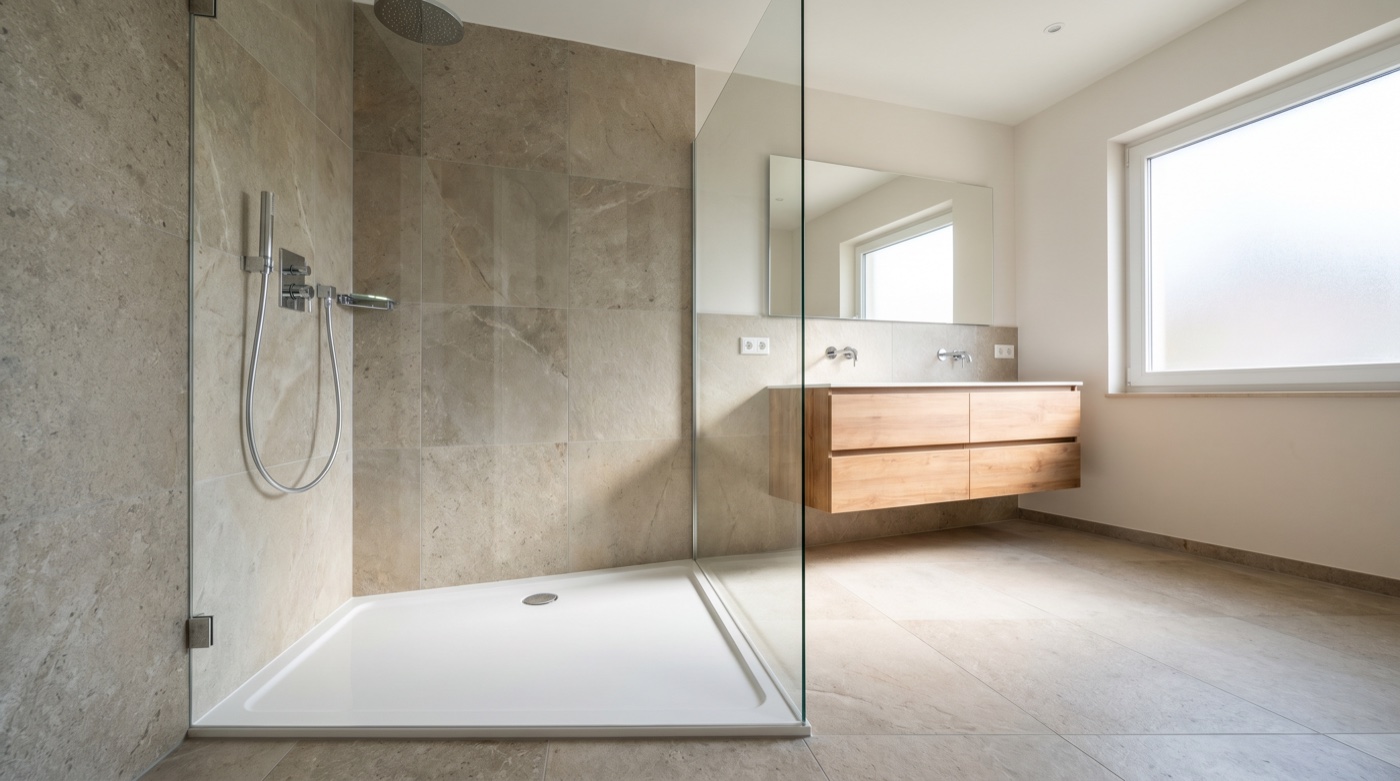
What counts as a small bathroom, and what renovations are actually viable
We consider a small bathroom to be anything between 2.5 and 5 square metres. In the province of Cádiz, social housing built in the 1970s and 80s typically comes with bathrooms of around 3 m², while detached and semi-detached homes in neighbourhoods such as Río San Pedro or La Isla tend to have secondary bathrooms that rarely exceed 4 m². Some cloakrooms in centrally located flats in Cádiz city centre barely reach 2 m².
The good news is that bathrooms of this size are perfectly suited to highly effective renovations. In spaces between 2.5 and 3 m², the most cost-efficient interventions are swapping the bath for a shower tray, replacing the tiles, and fitting compact sanitaryware. From 4 m² upwards you can start thinking about more ambitious reconfigurations, wall-hung vanity units, recessed niches, or even a small storage area. The key is tailoring the renovation to the actual space rather than working from a generic catalogue.
Before any decisions are made, we always carry out a free technical survey, measuring, photographing, and assessing the existing installations. This allows us to provide a detailed, no-surprises quote and to flag any hidden problems beforehand, such as rising damp, which is very common in ground-floor properties in Cádiz and San Fernando, before they become an unexpected extra cost.
Smart layouts: making every centimetre count in a narrow bathroom
The layout is where a small bathroom renovation is won or lost. A 10-centimetre error in the positioning of the toilet can mean the door won't open properly, or that the vanity unit you had your heart set on simply won't fit. That's why, in any narrow bathroom renovation in Cádiz, we always work from a dimensioned floor plan before anything is knocked down.
- Position the shower at the far end of the bathroom, using the longest wall. This frees up circulation space near the entrance.
- Use a wall-hung basin 45–50 cm deep rather than a pedestal model: you gain storage underneath and a visual sense of space.
- Replace a hinged door with a sliding or folding one. In a 3 m² bathroom you can reclaim up to 0.5 m² of usable floor space.
- Fit a compact toilet (48–50 cm projection rather than the standard 60 cm) to gain extra passing room.
- Make use of the walls with recessed shelves or niches in the shower area: storage without taking up any floor space.
In many flats in Cádiz city centre, bathrooms are long and narrow, sometimes only 1.20 m wide. In these cases, a linear layout (all fittings along a single wall) is often the only viable option. But with the right sanitaryware and a fixed frameless glass shower screen, the result can be surprisingly comfortable. If you have a square bathroom of around 2×2 m, an L-shaped layout lets you position the shower in one corner with the basin and toilet on the adjacent wall, making the most of the central space.
Replacing a bath with a shower: the most cost-effective renovation for small bathrooms in Cádiz
If there is one single renovation that transforms a small bathroom, it's replacing the bath with a shower. A standard bath takes up between 1.50 and 1.70 m in length by 0.70 m in width. Replacing it with a flush-to-floor shower tray (or even a wet-room-style shower with a built-in fall) can recover between 0.3 and 0.5 m² of usable floor space. In a 3 m² bathroom, that's 15% more free space.
In Cádiz and San Fernando, replacing a bath with a shower, including an ultra-low-profile tray, a fixed tempered glass screen, a single-lever mixer tap, and tiling in the shower zone, typically costs between €1,800 and €3,200, depending on the materials chosen and the condition of the existing plumbing. If the existing pipework is lead or galvanised iron (common in buildings pre-dating 1985) it's well worth replacing it at the same time, which adds between €400 and €800 but prevents problems further down the line.
Practical tip: If you want to renovate your small bathroom in Cádiz without major building work, replacing the bath with a shower can be completed in 2–3 working days with no need for a building permit, provided the layout isn't altered and no structural elements are touched. In most municipalities across the province, all that's required is prior notification to the local council (Ayuntamiento).
Our recommendation is to go for a resin or mineral-filled shower tray (such as Stonex or similar) in white or anthracite, measuring 120×70 cm or 100×70 cm depending on the available space. These are anti-slip as standard, stand just 3 cm high, and are far more durable than acrylic trays. For the screen, a fixed panel of 8 mm tempered glass without a bottom rail is the cleanest option visually and the easiest to maintain, no bottom seal where limescale can build up.
Materials that visually enlarge the bathroom: microcement, large-format tiles, and light colours
The choice of materials makes an enormous difference to how a small bathroom is perceived. The basic principle is to reduce grout lines and visual interruptions: the more continuous the surface, the larger the space will appear. That's why microcement has become one of the most popular finishes in small bathroom renovations across Cádiz. It's applied directly over existing tiles, eliminates grout lines entirely, and allows walls and floors to be refreshed with a layer just 2–3 mm thick.
Large-format tiles (60×120 cm or bigger) are another excellent option. Fewer grout lines than a conventional 30×60 cm tile mean the eye perceives a broader, more uniform surface. Light tones (off-white, pearl grey, sandy beige) reflect natural light and add to the sense of space. If you want to add character without cluttering the look, you can use a textured or relief tile on just one wall (the shower wall, for example) and keep the rest in a plain tone.
| Material | Approximate price (per m²) | Main advantage | Best suited to |
|---|---|---|---|
| Microcement | €50–80 | No grout lines; applied over existing tiles | Renovations without major building work |
| Large-format tiles (60×120 cm) | €25–55 | Fewer joints; premium look | Full renovations with new tiling |
| Standard tiles (30×60 cm) | €15–30 | Cost-effective; wide range of designs | Tighter budgets |
| Rectified porcelain | €30–50 | Minimal joints (1.5 mm); highly durable | Combined wall and floor finishes |
| Anti-damp paint | €8–15 | Minimal cost; quick to apply | Ceilings and mid-height areas |
A trick we use regularly in small bathroom renovations in Chiclana and San Fernando: using the same tile on both the floor and the walls (at least in the shower area) creates a sense of continuity that visually expands the space. If you also run the tiling all the way to the ceiling rather than stopping halfway up the wall, the bathroom will feel taller. These are design decisions that cost nothing extra but genuinely transform the end result.
Want to renovate your small bathroom? Request a free quote and we'll propose the best layout for your space.
Plumbing, ventilation, and electrics in small bathrooms: no nasty surprises
In a small bathroom, all the services are tightly concentrated, and any fault shows up quickly. Plumbing is the area where the most hidden problems lurk, particularly in older properties in Cádiz city centre and San Fernando. Lead pipes, asbestos-cement waste stacks, isolating valves that no longer shut off properly, these are situations we encounter in more than 60% of renovations we carry out in buildings built before 1990.
Our advice is straightforward: if you're opening up walls to replace the tiles, take the opportunity to renew all the exposed pipework and any accessible runs. Replacing lead pipework with multilayer or PEX pipe in a small bathroom costs between €400 and €900 and saves you call-outs and leaks in the future. For the drainage, a bottle trap recessed into the shower tray makes maintenance easier and reduces the risk of blockages.
- Ventilation: If your bathroom has no window (very common in internal bathrooms in Cádiz flats) fit a timer-controlled extractor fan wired to the light switch. Low-energy, low-noise models cost between €40 and €120.
- Electrics: The Low Voltage Electrotechnical Regulations require that zone 1 (the shower area) is free of sockets and switches. Check that your installation complies with ITC-BT-27 before starting the renovation.
- Water heater: If the electric immersion heater is inside the bathroom and taking up a lot of wall space, consider relocating it to the kitchen or switching to an instant gas water heater (where a flue outlet is available). You can reclaim up to 0.3 m² of wall space.
- Water connections: Have the supply connections recessed into the wall at the correct heights (110 cm for the shower mixer, 55 cm for the basin) to avoid exposed elbows and unsightly access panels.
How much does it cost to renovate a small bathroom in Cádiz in 2026
The cost of renovating a small bathroom in Cádiz in 2026 depends on the scope of the work, the materials chosen, and the condition of the existing installations. Below we set out real price ranges based on quotes we issue across the province, for a bathroom of between 3 and 5 m².
| Type of renovation | Approximate price | Estimated duration | What's included |
|---|---|---|---|
| Bath-to-shower conversion | €1,800 – €3,200 | 2–3 days | Shower tray, screen, mixer tap, partial tiling of shower zone |
| Partial renovation (no layout changes) | €3,500 – €5,500 | 5–7 days | Full retiling, new sanitaryware, mixer taps, vanity unit |
| Full renovation | €5,500 – €9,000 | 8–12 days | All of the above plus new plumbing, electrics, ventilation, painting |
| Premium full renovation | €9,000 – €14,000 | 10–15 days | High-end materials, microcement, concealed mixers, integrated LED lighting |
These prices include labour, materials, debris removal, and waste management. They do not cover unforeseen work such as repairs to shared waste stacks, structural reinforcement, or damp treatment, these are quoted separately if identified during the technical survey or at the start of the job. In our experience, roughly 25% of renovations in older buildings in Cádiz and San Fernando require some additional unplanned work, so we always recommend budgeting a contingency of 10–15% on top of the quoted price.
VAT on renovations to a main residence more than two years old is charged at the reduced rate of 10%, not the standard 21%. That's a significant saving. On a full renovation costing €7,000, for example, the difference between 10% and 21% VAT amounts to €770. Make sure your contractor applies the correct rate and shows it clearly on the invoice.
Renovating your small bathroom in phases: what to tackle first to avoid overspending
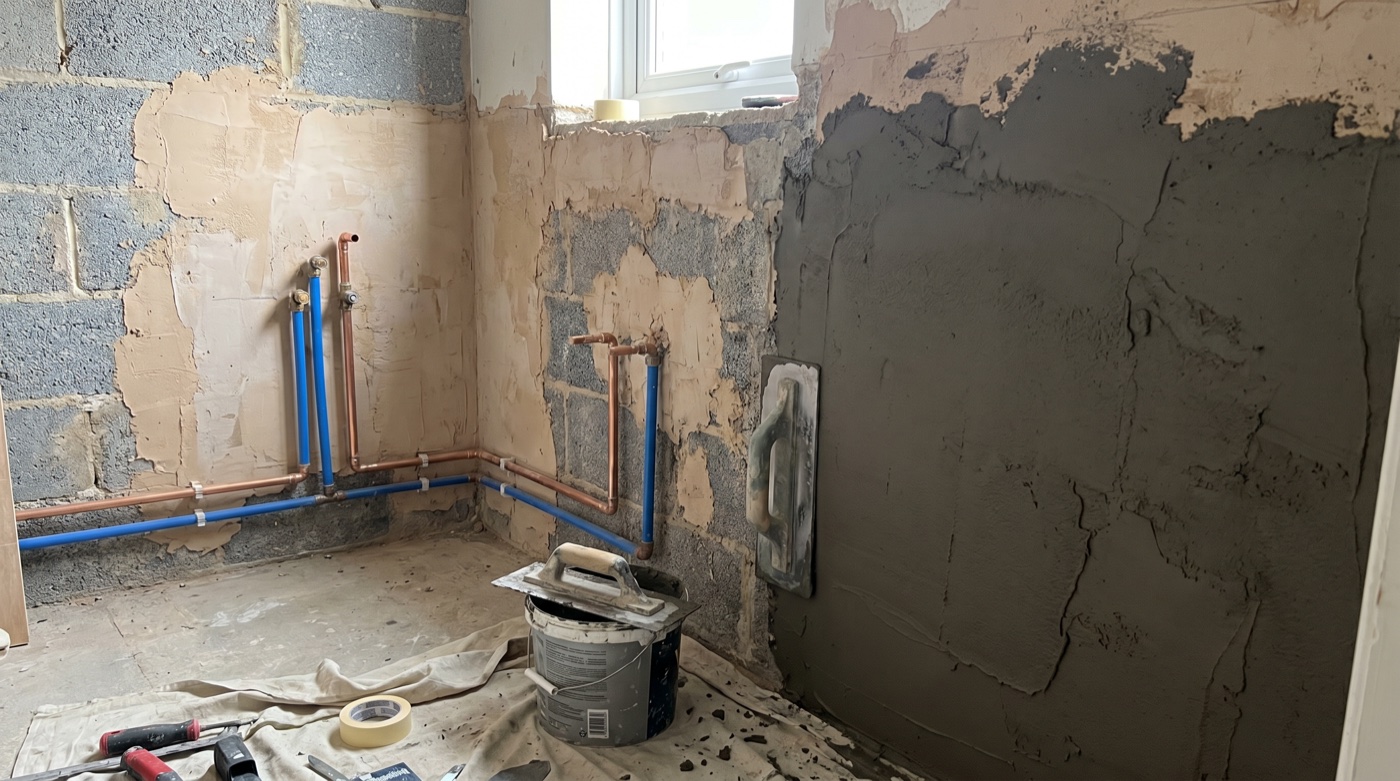
Not everyone can or wants to take on a full renovation all at once. If your budget is limited, a sensible strategy is to work in phases, prioritising the interventions that have the greatest impact and leaving the cosmetic improvements for later. That way you avoid taking on debt and can refresh the bathroom at your own pace.
- Phase 1, Plumbing and shower (high priority): If your pipes are old or you still have a bath, this is the most urgent intervention. Replace the bath with a shower, renew the exposed pipework, and fit a flush-to-floor tray. Outlay: €2,000–€3,500.
- Phase 2, Sanitaryware and vanity unit: Replace the toilet with a compact model and the basin with a wall-hung vanity unit with storage. You gain functionality and a fresh look without touching the walls. Outlay: €800–€1,800.
- Phase 3, Wall and floor finishes: Tile the walls and floor with large-format materials, or apply microcement over the existing tiles. Outlay: €1,500–€3,500 depending on the material.
- Phase 4, Finishing touches: Designer taps, LED lighting, coordinating accessories, a mirror with integrated lighting. Outlay: €500–€1,500.
If you go down this route, it's important to plan all the phases from the outset so that decisions made in one phase don't create problems in the next. For example, if at phase 1 you already know that at phase 3 you'll be laying large-format tiles, leave the walls prepared with a smooth render rather than tiling them temporarily with cheap material you'll only have to remove later. At Reformas By Bianca we help you design the full plan even if you're only carrying out the first phase right now.
How to choose a bathroom renovation company in Cádiz: the right questions to ask before you sign
Choosing the right company for a small bathroom renovation in Cádiz matters just as much as choosing the right materials. Poor workmanship in a small space stands out far more than it would in a larger bathroom, a crooked grout line, a shower tray with the wrong fall, or a screen that isn't plumb can ruin the whole result. These are the questions you should be asking before you sign a quote.
- Is the quote fixed-price and itemised by trade (demolition, plumbing, tiling, sanitaryware, labour), or is it a single lump-sum figure with no breakdown?
- Does it include waste removal and transport to a licensed tip?
- Who actually carries out the work, the company's own directly employed team, or subcontractors?
- Do they offer a written guarantee on the workmanship? The legal minimum is one year, but reputable companies offer two or more.
- Can they show you photos or videos of completed small bathroom renovations in the Cádiz, San Fernando, or Chiclana area?
- Do they hold public liability insurance covering damage during the works, both to your property and to neighbouring ones?
At Reformas By Bianca we work with our own directly employed team, we provide fixed-price itemised quotes, and we guarantee our workmanship for 2 years. We operate throughout the Bay of Cádiz, Cádiz city, San Fernando, Chiclana, Puerto Real, El Puerto de Santa María, and we carry out the technical survey with no obligation. If you're thinking about renovating your small bathroom in Cádiz, get in touch and we'll prepare a personalised proposal with a 3D render so you can see the result before work begins.
Renovating a small bathroom doesn't have to be a headache. With the right layout, the right materials, and a professional team that understands the quirks of homes across the province, you can turn that cramped, dated bathroom into a functional, attractive, and long-lasting space. And the best part: without spending a penny more than you need to.