Microcement vs Tiles in Bathroom and Kitchen: Which to Choose for Your Renovation in Cádiz?
When the time comes to renovate your bathroom or kitchen, one of the first decisions you'll need to make is what type of surface covering to use on the walls and floors. In Cádiz, where ambient humidity and proximity to the sea directly affect which materials hold up well, this choice carries particular weight. Microcement vs tiles in bathrooms and kitchens is, without question, the dilemma our clients raise most often. In this guide we give you everything you need (costs, durability, timescales and aesthetics) so you can make the right call for your situation and your budget.
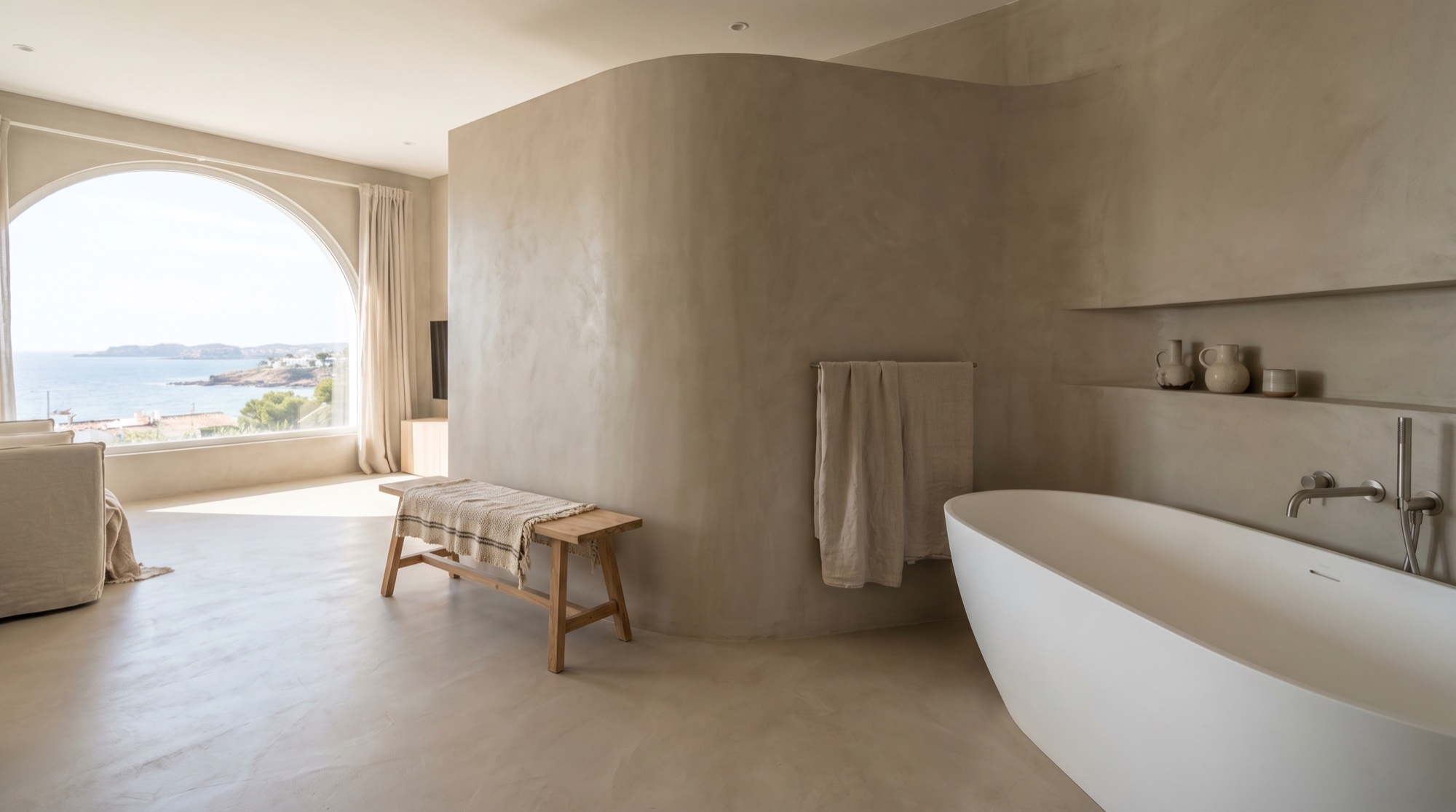
What is microcement and how does it differ from tiles?
Microcement is a seamless surface coating made up of cement, polymer resins, fibres and pigments, applied in layers just 2–3 mm thick over virtually any existing surface: old tiles, concrete, plasterboard or even wood. Its defining characteristic is that it has no grout lines, producing a uniform, contemporary finish. Unlike traditional tiling, microcement moulds to the shape of the substrate without any need to demolish what is already there.
Tiles, on the other hand, are individual ceramic pieces laid with adhesive mortar and requiring grout joints between each one. They come in sizes ranging from small 5×5 cm mosaics all the way up to large-format slabs of 120×260 cm. In Cádiz, tiling has a centuries-old tradition, a stroll through the old town reveals magnificent examples of Andalusian ceramics, and it remains the most widely used option for bathroom and kitchen renovations, thanks to its proven resistance to water and damp.
The fundamental difference between microcement and tiles in kitchens and bathrooms is not purely aesthetic: the two involve distinct installation processes, different budgets, and opposing maintenance requirements. Microcement offers a seamless, continuous finish that eliminates the build-up of mould in grout lines; tiles offer superior mechanical strength and a practically limitless range of designs. Understanding these differences is the first step towards getting your renovation right.
Microcement vs. tiles at a glance
Microcement
- Seamless, grout-free finish
- Applied over existing surfaces
- Reseal every 3-5 years
- 15-20 year lifespan
Tiles
- Top durability, no maintenance
- Resists grease and knocks
- Grout lines: weak point for mould
- 25-40 year lifespan
Cost of microcement vs tiles in Cádiz bathrooms and kitchens
The price of microcement for a bathroom in Cádiz ranges from €60 to €120/m² installed, depending on the quality of the product, the number of coats and the final finish (matt, satin or gloss). This price includes the primer, the base and finishing coats of microcement, and the protective sealant. The professional brands most commonly used in the province (such as Topciment, Luxury Concrete and Cementart) sit at the upper end of that range, while mid-range products tend to come in at around €65–80/m².
With tiles, the total cost depends on the price of the tile itself and the labour for fitting. A good mid-range tile costs between €20 and €45/m², to which you need to add the labour of a professional tiler (between €25 and €40/m² in Cádiz city and the surrounding province) and the adhesive and grout materials (around €5–8/m²). The overall cost of tiles fully installed therefore comes out at €50–93/m², which is comparable to microcement in many scenarios.
| Item | Microcement (€/m²) | Mid-range tiles (€/m²) |
|---|---|---|
| Materials | 30 – 55 | 20 – 45 |
| Labour | 25 – 50 | 25 – 40 |
| Adhesive / Sealant | 5 – 15 | 5 – 8 |
| Total installed cost | 60 – 120 | 50 – 93 |
| Guide cost: 8 m² bathroom | €480 – €960 | €400 – €744 |
| Guide cost: 15 m² kitchen | €900 – €1,800 | €750 – €1,395 |
As you can see, the cost difference between tiles and microcement is not enormous when you compare products of similar quality. Microcement does tend to be slightly more expensive in most cases, but the gap narrows when you factor in that it does not always require stripping out the existing surface first: in a no-demolition bathroom renovation in Cádiz, applying microcement over the existing tiles can save between €800 and €1,500 in demolition and skip-hire costs.
Practical tip: If your budget is tight but you want a contemporary finish, consider applying microcement only to the bathroom walls and keeping a large-format ceramic floor. This combination lets you achieve a modern bathroom look in Cádiz without blowing the budget, and it is a solution we use regularly in our renovations.
Durability and maintenance: which holds up better in damp conditions?
In a city like Cádiz, where relative humidity averages 70–75% for much of the year and the salt-laden sea breeze is a constant presence, the durability of your surface covering is no minor consideration. Ceramic tile (particularly porcelain stoneware) is virtually impermeable (water absorption below 0.5%), resistant to salt, aggressive cleaning products and moderate impacts. A quality tile, properly fitted, can last 30 years or more without needing replacement.
Properly sealed microcement is also resistant to damp and direct water contact, but it requires periodic maintenance that tiles simply do not. Every 3–5 years it is worth renewing the protective sealant coat (at a cost of €8–15/m²) to maintain its waterproofing and prevent staining. Furthermore, microcement that has been poorly sealed or is of low quality can develop hairline cracks or absorb moisture, a particularly problematic issue in bathrooms in Cádiz, where exposure to steam is constant.
- Porcelain stoneware tiles: water absorption below 0.5%, resistant to salts, acids and cleaning products. Lifespan of 25–40 years with no special maintenance.
- Sealed microcement: waterproof as long as the sealant is in good condition. Sealant needs renewing every 3–5 years. Lifespan of 15–20 years with proper upkeep.
- Tile grout lines: the weak point where mould can take hold in damp areas. Solution: epoxy grout, which is waterproof and antimicrobial.
- Seamless microcement: eliminates the build-up of dirt and mould between pieces. Day-to-day cleaning is easier with a damp cloth and neutral detergent.
- In kitchens: tiles hold up better against grease splashes and knocks from utensils. Microcement in the kitchen has the advantage of no grout lines trapping grime, but it can stain if spills are not wiped up promptly.
When comparing microcement against porcelain stoneware in a bathroom, porcelain wins on outright durability and on low-maintenance resilience. But microcement wins on day-to-day ease of cleaning, as there are no grout lines for the hard limescale-heavy water common in Cádiz to collect in, something we know all too well in this province. The choice ultimately comes down to whether you prefer a material you can simply forget about (tiles) or one that needs a degree of care but rewards you with an immaculate finish (microcement).
Want a custom kitchen that makes the most of every centimetre? Request a no-obligation quote for your kitchen in Cádiz.
Aesthetics and trends: microcement for a contemporary look vs classic tiles
Microcement for bathrooms in Cádiz has become the go-to option for those looking for a modern finish. Its seamless, uninterrupted surface creates a visual sense of space that works particularly well in small bathrooms, very common in flats in the centre of Cádiz, Chiclana and El Puerto de Santa María. The most popular colours in the province are sand tones, pearl grey and off-white, which sit beautifully with the natural Atlantic light of the area.
Tiles, far from being left behind, are going through something of a renaissance. Large formats (60×120, 80×160 cm) with stone, wood or marble effects can achieve a thoroughly contemporary look with fewer visible joints. Handmade-style tiles such as zellige are also having a moment, bringing texture and character to kitchens and bathrooms with a nod to the Andalusian ceramic tradition. In our renovations across Cádiz, we are seeing more and more clients combine both materials: microcement on the walls with a large-format ceramic floor, or a decorative tiled feature wall with microcement on the remaining surfaces.
Microcement floors in open-plan kitchens are another growing trend, particularly where the kitchen flows into the living room and a consistent floor surface is desired throughout. The result is a fluid, elegant space with no material breaks underfoot. That said, it is important to specify an anti-slip finish (class C2 or C3) when microcement is used on floors, especially in areas where water or grease may be present.
Installation and timescales: which option is faster?
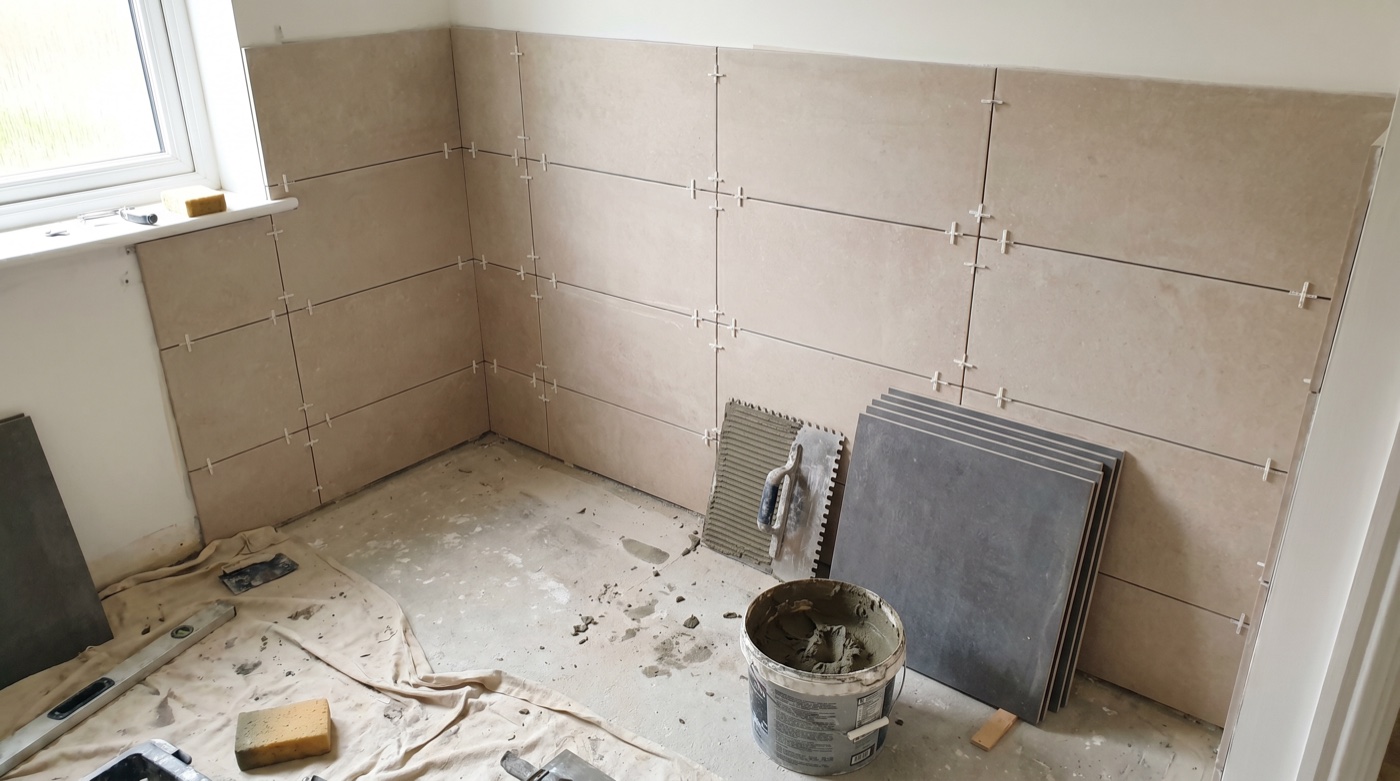
Timescales are a decisive factor for many households, particularly when the renovation involves the only bathroom in the property. Installing microcement in a standard bathroom (walls and floor, roughly 15–20 m²) takes between 5 and 7 working days: 1 day to prepare the substrate, 2–3 days to apply the microcement coats with their intermediate drying times, and 1–2 days for the final sealing and curing. Microcement requires a minimum of 48–72 hours of curing time before the area can be used normally.
Conventional tiling of a bathroom of similar size takes between 3 and 5 days to install, plus 24 hours for the mortar and grout to set. However, if the existing surface needs to be stripped out before the new tiles can go in, you need to add 1–2 days of demolition work and another day for clearing up and preparing the surface. All told, a full tile renovation involving prior demolition can stretch to 6–8 working days.
This is where renovating a bathroom with microcement shows a clear advantage: because it can be applied directly over the existing tiles, it eliminates the demolition phase entirely. That makes microcement the ideal choice for a no-disruption bathroom renovation in Cádiz, cutting not only the timescale but also the noise, dust and rubble. In flats within residents' communities in the historic centre, where building works can cause considerable inconvenience to neighbours, this advantage is something our clients value enormously.
When to choose microcement and when to choose tiles for your particular situation
There is no one-size-fits-all answer to the microcement-or-tiles debate for kitchens and bathrooms. The best option depends on your specific circumstances: budget, the current state of the property, the style you are after, and how much ongoing maintenance you are willing to take on. Having carried out hundreds of renovations across the province of Cádiz, at Reformas By Bianca we have identified the scenarios where each material really comes into its own.
Choose microcement if you want a seamless finish in your Cádiz bathroom or kitchen without needing to demolish what is already there, if your priority is a modern aesthetic and a sense of space, if you want to keep the disruption and timescale of the work to a minimum, or if you are renovating a small bathroom where visible grout lines would make the space feel even more cramped. It is also the best option for open-plan kitchen floors where you need visual continuity with the living area.
Choose tiles if long-term durability without maintenance concerns is your priority, if your budget is tighter (particularly over larger surface areas), if the area is going to see very heavy use (busy family kitchens, high-traffic guest bathrooms), or if you are after specific decorative designs (mosaics, geometric patterns, handmade ceramics) that only tiles can deliver. In kitchen areas that are regularly hit with grease splashes, ceramic tiles remain the more practical choice.
| Situation | Best option |
|---|---|
| Small bathroom, contemporary aesthetic | Microcement |
| Open-plan kitchen to living room (continuous floor) | Microcement |
| Quick renovation without demolition | Microcement |
| Maximum durability with no maintenance | Porcelain stoneware tiles |
| Tight budget over large surface areas | Tiles |
| Heavy grease splashes (kitchen splashback area) | Tiles |
| Decorative or handmade designs | Tiles |
| Property close to the sea (high salinity) | Porcelain stoneware tiles |
Frequently asked questions about microcement and tiles for renovations in Cádiz
Below we answer the questions our clients ask most often when deciding between microcement and tiles for their renovation in Cádiz. If your question is not covered here, feel free to get in touch with us directly.