Glass curtains for terraces in Cádiz cost between €250 and €550/m² installed, depending on glass thickness and system type. They are the lightest, brightest way to protect a terrace from the Levante wind and rain without giving up the views or the outdoor feel, and without the building work a fixed enclosure involves.
But not everyone needs the same thing: a daily-use terrace in a city-centre flat is not the same as an exposed penthouse on the seafront. In this guide we give you prices updated to 2026 based on real projects in Cádiz city, San Fernando, Chiclana and the rest of the Bay, and help you decide whether glass curtains are right for you or a fixed enclosure suits you better.
What glass curtains are (and what they are not)
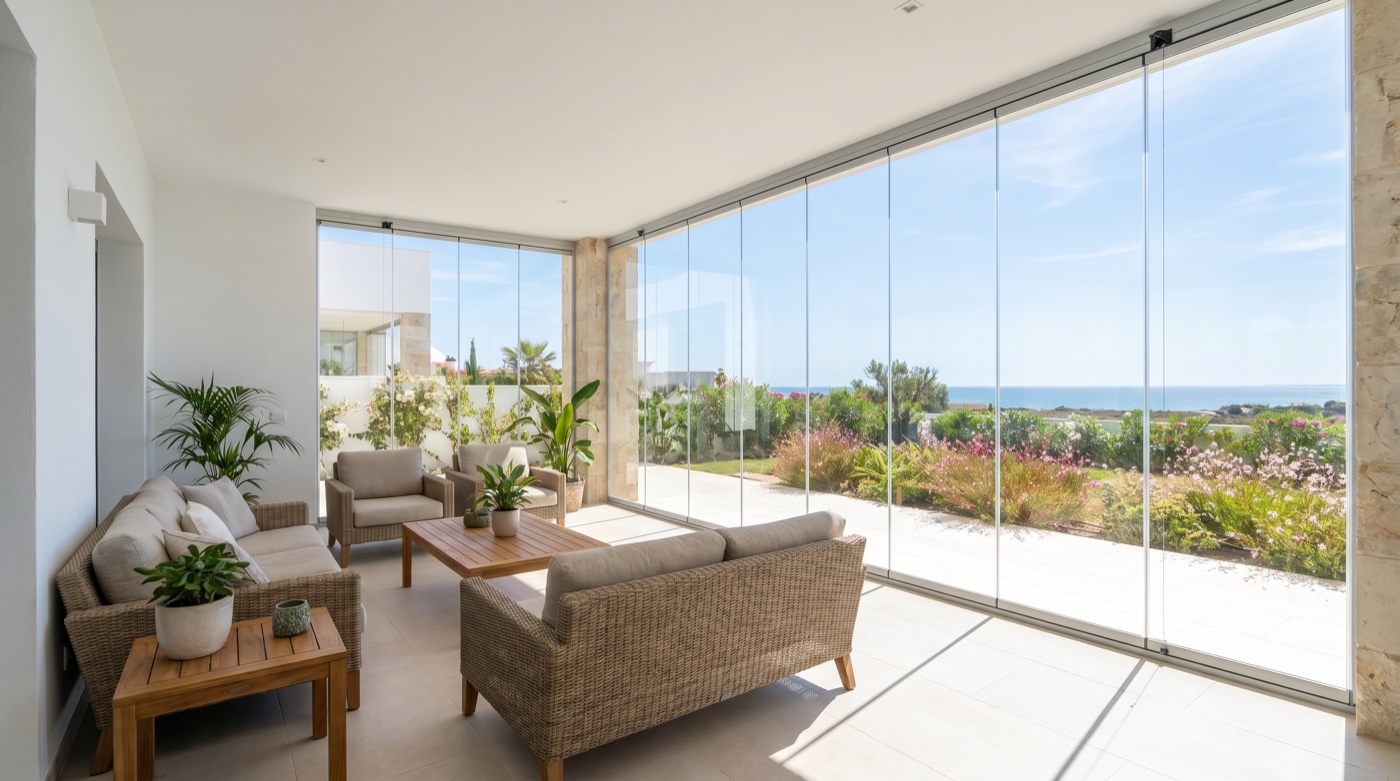
Glass curtains are panels of tempered glass, with no vertical framing between them, that slide and fold or stack to one side. When open, the terrace is left almost completely clear; when closed, they form a continuous glass wall that blocks wind and rain. Their big advantage is the light and a minimalist look that is barely noticeable.
What they are not is an insulating enclosure. They have no thermal break, the joints between panels are not fully airtight and the glass is usually single (not double glazing). This means they protect from wind and water, but they do not insulate against cold or heat like a fixed enclosure, and they do not count as habitable floor area for energy certification or land-registry purposes.
Types of glass curtain
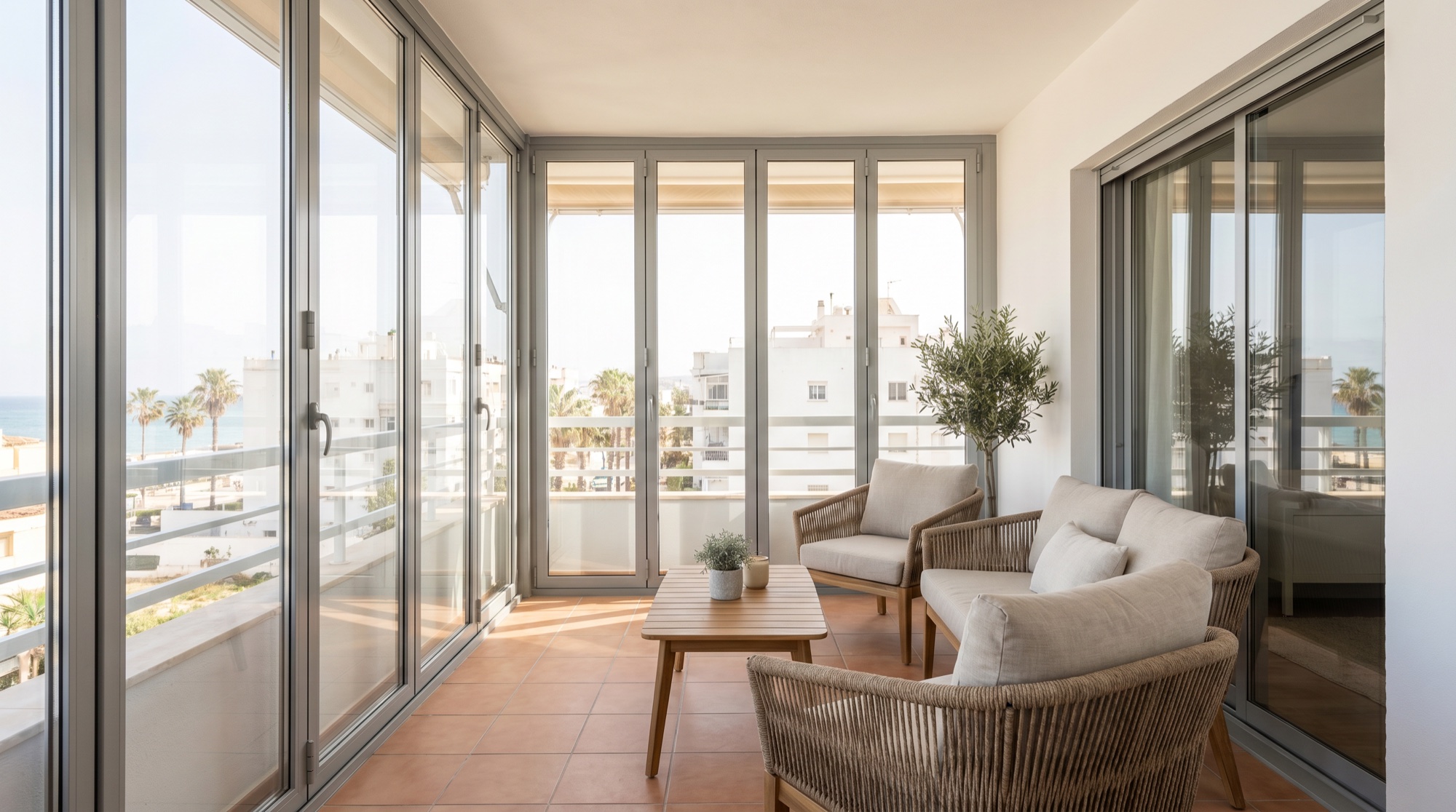
The most common system is the folding glass curtain: the panels pivot and stack against one or both sides, leaving the opening almost fully clear. There are also sliding systems, where the panels slide one behind another without folding; they take up less depth when open but do not clear the opening completely. The choice depends on the shape of your terrace and how much you want to open it up.
- Glass thickness: 8 mm for small, sheltered openings, 10 mm for most terraces, and 12 mm for large heights or areas heavily exposed to the Levante wind. The thicker the glass, the higher the price and the greater the wind resistance.
- With or without a bottom track: the bottom track adds rigidity and weathertightness; the floor-track-free version is easier to walk over and clean, but withstands less wind.
- Corners and curves: the systems can enclose L-shaped or cornered terraces, and even curved layouts, but the bespoke manufacturing raises the price per square metre.
Glass curtain prices in Cádiz (2026)
As a reference, these are the prices per installed square metre we work with in the province of Cádiz, with the tempered glass, tracks and installation included:
| System / thickness | Price per m² | 8 m² terrace | Recommended for |
|---|---|---|---|
| 8 mm glass | €250–350/m² | €2,000–2,800 | Small, sheltered openings |
| 10 mm glass | €330–450/m² | €2,640–3,600 | Most terraces in Cádiz |
| 12 mm glass or large height | €420–550/m² | €3,360–4,400 | Seafront, strong Levante wind |
| With bespoke curves or corners | +15–25% | Depends on layout | L-shaped or curved terraces |
Prices include survey, bespoke manufacture, stainless-steel hardware and installation. They do not include civil works if the floor needs levelling or the parapet reinforcing, nor municipal permits. In developments in Chiclana, San Fernando or El Puerto it is common for the community to require a uniform model and colour, so it is worth checking before deciding.
Want to enclose your terrace with glass curtains in Cádiz? Request a no-obligation quote and we'll advise on the thickness and system that best suit your terrace and your community.
Price examples by terrace size
| Terrace | 10 mm glass curtain | Typical use |
|---|---|---|
| 4 m² (narrow gallery) | €1,300–1,800 | Laundry, small office |
| 6 m² (flat terrace) | €2,000–2,700 | Outdoor sitting area |
| 8 m² (medium terrace) | €2,640–3,600 | Outdoor dining or lounge |
| 12 m² (penthouse or porch) | €4,000–5,400 | Daily-use room |
Glass curtains vs fixed enclosure: which to choose?
The decision depends on what you will use the terrace for. If you only want to protect it from wind and rain while keeping the outdoor feel and maximum light, glass curtains are cheaper, lighter and open up completely in summer. If instead you want a climate-controlled space that works as another room 365 days a year, with thermal and acoustic insulation, you need a fixed aluminium enclosure with thermal break or a PVC one with double glazing.
In our experience in Cádiz, those who choose glass curtains tend to be delighted in spring and autumn, but find them a bit short during the peak heat of July and August (without insulation, single glass lets heat through) and on days of heavy rain with side wind. If your priority is to use the terrace even in high summer or winter, consider the fixed enclosure from the outset.
Tip: before requesting a quote, ask your property manager whether the community allows glass curtains and with what specifications (profile colour, opening type). And in Cádiz, always insist on stainless-steel hardware: with the salt air, ordinary hardware seizes up within months.
Do I need a permit to install glass curtains?
In most Cádiz municipalities, glass curtains are considered a movable, removable element, so they are usually processed with a responsible declaration or minor works permit, a simpler procedure than a fixed enclosure. Even so, if the terrace faces the exterior of the building or the property is in the historic centre of Cádiz city, it may require specific authorisation. And in all cases, if the terrace is a communal element or the installation affects the facade, you need the agreement of the residents' community.
Factors that affect the price
- Panel height: above 2.5 m (common in ground floors and older Cádiz buildings) the glass is larger and more expensive, and usually requires 12 mm for safety.
- Wind exposure: on the seafront or areas heavily hit by the Levante wind, thicker glass and a reinforced bottom track are needed, which raises the price.
- Curves and corners: enclosing an L-shaped or curved terrace requires bespoke panels and tracks, with a 15–25% surcharge.
- Preparatory works: levelling the floor, reinforcing the parapet or running an electrical supply for lighting can add between €300 and €1,200 to the project.
- Extras: anti-limescale glass treatment, a flush concealed track or solar-control glass add between 10% and 20% to the base budget.
Maintenance and salt air in Cádiz
Maintenance of glass curtains is minimal: cleaning the glass and tracks and greasing the hardware once or twice a year. The key in Cádiz is the hardware: in the salty environment, only quality stainless steel holds up without seizing. If you live on the seafront, the anti-limescale glass treatment saves you most of the cleaning, because water slides off without leaving lime marks.
Are glass curtains worth it?
If you want to gain months of use from your terrace by protecting it from wind and rain without giving up light or views, and on a tighter budget than a fixed enclosure, glass curtains are an excellent and much-demanded solution in Cádiz. If instead you want to turn the terrace into a climate-controlled, daily-use room all year round, it pays to invest in a fixed insulated enclosure. On the free visit we tell you frankly which option gives you the best return.