A plasterboard false ceiling is one of the most versatile elements in a renovation. It allows you to conceal services (electrics, plumbing, air conditioning), improve thermal and acoustic insulation, integrate recessed LED lighting and correct uneven or damaged ceilings. In flats in central Cádiz with high ceilings (3–3.5 m), a well-planned false ceiling also helps reduce the volume of the space, improving climate control efficiency.
In this guide we give you real installation prices in Cádiz, compare the different types of board, explain the process step by step and review the most frequent issues we encounter in the ceilings of Cádiz flats, especially in neighbourhoods like El Pópulo, La Viña and Santa María, where older buildings present specific challenges.
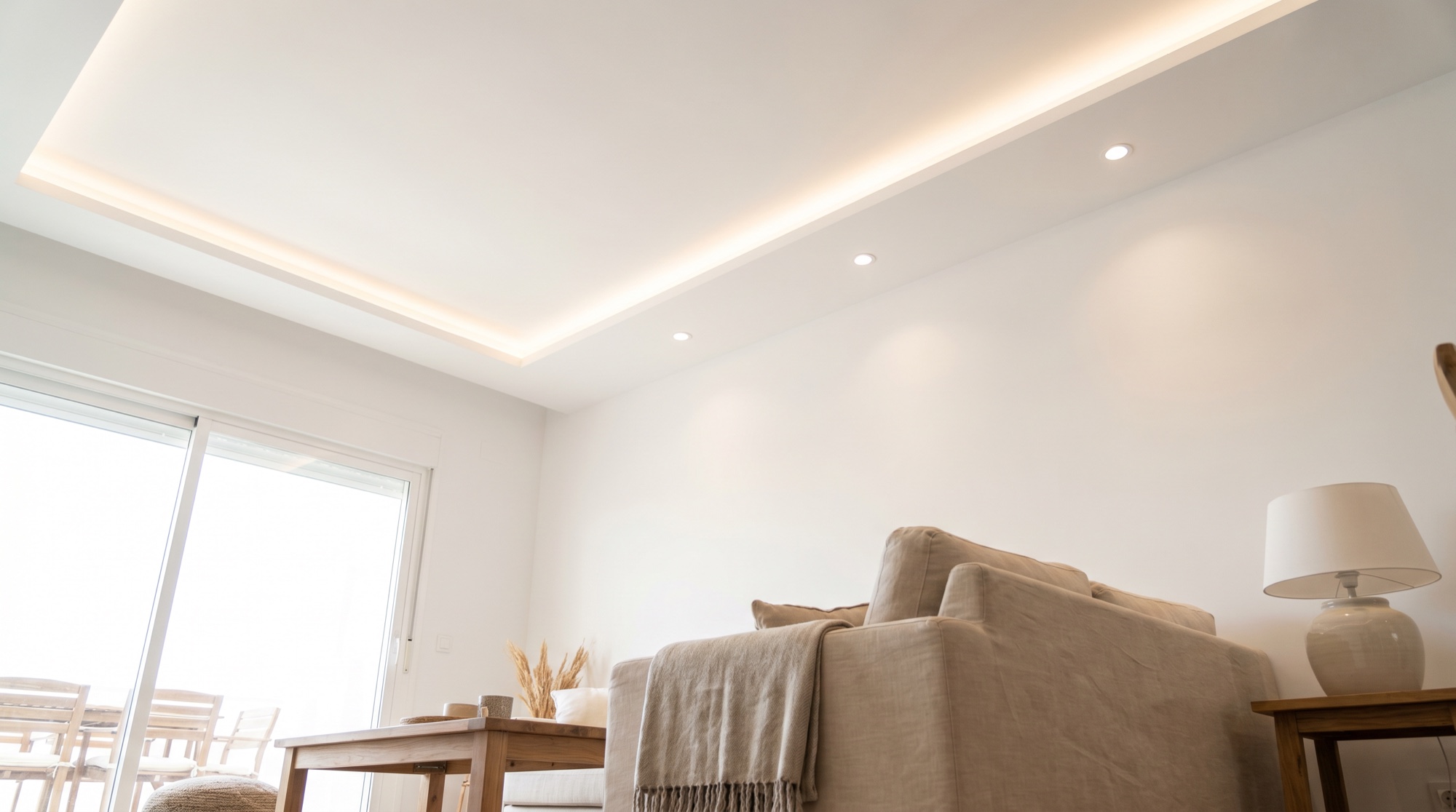
Plasterboard false ceiling prices in Cádiz (2026)
| Type | Price per m² | 80 m² flat |
|---|---|---|
| Flat continuous (no LED) | €25–35/m² | €2,000–2,800 |
| With perimeter cove for LED | €35–45/m² | €2,800–3,600 |
| With thermal/acoustic insulation | €40–55/m² | €3,200–4,400 |
| Accessible (for commercial) | €20–30/m² | — |
Prices include the metal framework, plasterboard sheets, jointing tape, sanding and one coat of paint. They do not include lighting (recessed LED spotlights cost €15–30 per installed point) or air conditioning (only preparation of the opening for the unit).
False ceiling cost by room
The cost varies by room because each area has different requirements: the bathroom and kitchen need moisture-resistant board, the living room usually calls for an LED cove and hallways are narrow and quick to complete. This breakdown helps you decide which rooms are worth fitting with a false ceiling.
| Room | Typical area | Recommended type | Indicative cost |
|---|---|---|---|
| Bathroom | 4–6 m² | Moisture-resistant flat | €160–300 |
| Kitchen | 8–12 m² | Moisture-resistant with LED spots | €350–550 |
| Living room | 18–25 m² | Perimeter LED cove | €700–1,200 |
| Bedroom | 10–14 m² | Flat or with acoustic insulation | €350–650 |
| Hallway | 4–8 m² | Flat with LED spots | €150–350 |
Plasterboard types: which to use in each situation
Not all plasterboard sheets are the same. Choosing the right board for each area is fundamental to ensuring the false ceiling lasts and performs well. In Cádiz, where Atlantic humidity and salt spray are constant, the choice of board is especially important.
| Board type | Colour | Recommended use | Extra cost vs standard |
|---|---|---|---|
| Standard (N) | White/grey | Living rooms, bedrooms, hallways | Base price |
| Moisture-resistant (H) | Green | Bathrooms, kitchens, utility rooms | +15–20 % |
| Fire-resistant (F) | Pink | Kitchens near heat, garages, commercial | +20–30 % |
| Acoustic (perforated) | White perforated | Bedrooms facing noisy streets, living rooms | +30–50 % |
| High-density (HD) | Blue | Commercial premises, high-traffic areas | +25–35 % |
Tip: if you only need a false ceiling in wet areas (bathroom, kitchen), use moisture-resistant plasterboard (green). It costs 15–20 % more but withstands humidity without deteriorating. In Cádiz, with constant Atlantic humidity, this investment is essential even in kitchens that do not generate much steam.
When is a false ceiling worthwhile?
- Full renovation: the ideal time. Services run across the ceiling and are concealed neatly. The cost is marginal within the total budget.
- Ducted air conditioning: essential to conceal the machinery and distribution ducts.
- Ceilings with damp or cracks: a false ceiling covers the issue aesthetically while the cause is addressed in the layer above.
- Flats with high ceilings (>3 m): reduces the volume to be climate-controlled, saving energy. Very common in the Cádiz old town.
Need to install a false ceiling in your flat in Cádiz? Request a no-obligation quote.
Height loss: how much does the ceiling actually drop?
Height loss is the biggest concern for clients, especially in flats in Extramuros or Bahía Blanca with 2.50 m ceilings. The drop depends on what needs to be housed in the plenum (the cavity between the original ceiling and the false ceiling).
- Board only (no services): 5–8 cm drop. This is the technical minimum for the metal framework.
- Recessed LED spotlights: 8–12 cm. Ultra-slim spotlights keep the drop to 8 cm.
- Electrical wiring and plumbing pipes: 10–15 cm. Sufficient for most residential services.
- Ducted air conditioning: 20–30 cm in the indoor unit area, 15–20 cm in the distribution duct zones.
- Old town flats with 3–3.5 m ceilings: a 15–25 cm loss is imperceptible and actually improves the proportions of the space.
LED lighting integration in the false ceiling
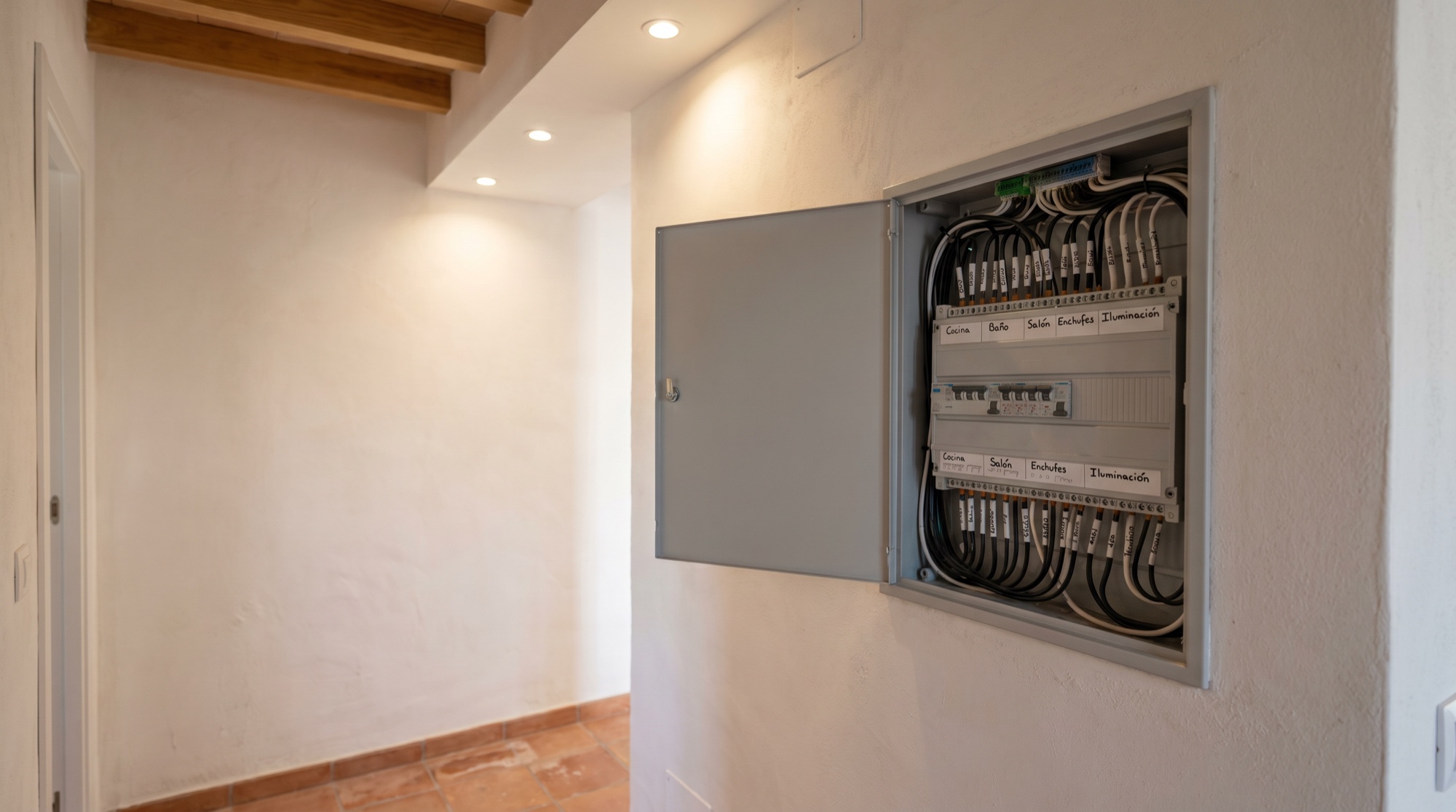
Lighting is one of the main reasons for installing a false ceiling. Good lighting design completely transforms the perception of a space. These are the costs of the most common options in Cádiz renovations.
- Recessed LED spotlights: €15–30 per installed point. 1 spotlight per 2–3 m² is recommended in general areas, and 1 per 1.5 m² in kitchens and bathrooms. A 20 m² living room needs 7–10 spotlights (€105–300).
- LED strip in perimeter cove: €8–15 per linear metre installed. Creates very pleasant indirect light as ambient lighting. A 20 m² living room with a perimeter cove (roughly 18 linear metres) costs €144–270 for the LED strip alone.
- Recessed LED panels (slim type): €40–80 per installed unit. They are a modern, even alternative to spotlights, especially popular in kitchens and hallways.
- Dimmer switch: €30–60 per circuit. Allows you to adjust light levels throughout the day and saves energy.
Common ceiling problems in older Cádiz flats
Flats in the old town of Cádiz, particularly in El Pópulo, La Viña and Santa María, present specific ceiling problems that you should be aware of before installing a false ceiling. It is not just about aesthetics: some of these issues must be resolved before the framework goes up.
- Damp from roof leaks: very common on top floors in the old town. The roof must be waterproofed before the false ceiling goes in, otherwise moisture will continue to accumulate in the unventilated cavity. Waterproofing cost: €15–30/m² of roof area.
- Salt and efflorescence: Atlantic humidity and proximity to the sea cause salt deposits on ceilings, especially in ground-floor flats in La Viña and the Paseo Marítimo area. Pre-treating the original ceiling with an anti-salt product costs €3–5/m².
- Reed or irregular plaster ceilings: in buildings from before 1960, many ceilings are reed mats over timber beams. They are uneven and cannot support standard fixings. The false ceiling framework is anchored to walls and beams, not to the reed, which may require adaptations (extra cost of €5–10/m²).
- Exposed timber beams: in El Pópulo flats, many ceilings have wooden beams that the owner wants to keep. In that case, the false ceiling is installed between the beams, not below them, preserving the aesthetic while concealing the services.
Installation process step by step
Knowing the installation phases helps you plan the works and understand the timescales. In a typical 80 m² flat, complete false ceiling installation takes between 3 and 5 days.
- Setting out and level marking: the false ceiling height is marked with a laser on all walls. The drop is decided based on the services to be concealed. (Half a day)
- Metal framework installation: U-profiles are fixed to the walls and threaded rods are hung from the original ceiling. T-profiles are assembled to form the support grid. (1 day)
- Services routing: electricians and plumbers run their cables and pipes through the cavity before the ceiling is closed. (Overlaps with other works)
- Plasterboard installation: boards are screwed to the framework. Openings are left for spotlights, air conditioning diffusers and access panels. (1–2 days)
- Taping, filling and sanding: joints are sealed with paper tape and filler, then sanded to achieve a smooth surface. (1 day)
- Painting: one coat of primer and one or two coats of matt white emulsion. (Half a day)
Factors that affect the price in Cádiz
- Ceiling height: in ceilings over 3 m (common in El Pópulo and La Viña), installation requires scaffolding rather than ladders, which can add 5–10 % to the labour cost.
- Building access: in narrow streets of the old town, carrying 2.4 x 1.2 m boards up through tight stairwells by hand increases the time and logistics cost by 5–15 %.
- Condition of the original ceiling: if there is active damp, salt or structural problems, these must be resolved before the false ceiling is installed, adding between €500 and €2,000 to the budget.
- Design complexity: a flat ceiling is faster than one with multiple levels, curved coves or special shapes. Each additional level adds 20–30 % to the cost of that area.
- Climate control: if the Levante wind (frequent in summer in Cádiz) demands heavy air conditioning use, integrating ducts in the false ceiling is an investment that pays for itself quickly in comfort and efficiency.
Common mistakes when installing a false ceiling
- Not planning access panels: if there are services in the cavity (valves, junctions, air conditioning unit), you need access hatches to reach them without breaking the ceiling. Adding a hatch costs €30–50; breaking and repairing the ceiling afterwards costs €150–300.
- Installing standard board in wet areas: in Cádiz bathrooms and kitchens, where relative humidity exceeds 70 % for much of the year, standard board swells and stains within months. Always use moisture-resistant board (green).
- Not considering height loss in low-ceilinged flats: if your flat has 2.50 m ceilings and you subtract 15–20 cm for ducts, the resulting height (2.30–2.35 m) can feel oppressive. Consult with your renovation team before deciding.
- Forgetting the insulation: the false ceiling is the perfect opportunity to add a mineral wool blanket (€3–5/m²) that dramatically improves acoustic insulation from the neighbour above and reduces heat loss in winter.