Pladur vs Brick Wall: Which to Choose for Your Renovation in Cádiz?
If you're planning a renovation in Cádiz, one of the first decisions you'll face is how to build or divide the interior spaces of your home. Plasterboard or brick: it's the age-old question. And it's not a trivial one, because it affects your budget, thermal comfort, acoustic performance, and (in a coastal city like Cádiz) long-term durability against damp. At Reformas By Bianca we work with both systems every day, and we know there's no one-size-fits-all answer. What does exist is the right solution for each specific situation, and that's exactly what this guide will help you find.
What is plasterboard and what is a brick partition wall? The basic differences
Plasterboard (also known as drywall or gypsum board) is a construction system made up of a galvanised metal frame onto which plasterboard sheets are screwed. Mineral wool or rock wool can be placed between the boards to improve insulation. It's a dry system: no mortar, no cement, no curing time, which makes it invaluable in renovations where speed and minimal mess are a priority.
Brick partition walls, on the other hand, are the traditional system that has been used in Spanish construction for decades. They involve building a wall with hollow bricks (typically 7 cm thick for interior partitions) bonded with cement mortar, which is then plastered and painted. It's a wet system that requires drying time, generates rubble and dust, but offers a solidity and structural strength that many homeowners particularly value.
The fundamental difference between plasterboard and brick comes down to their structural nature. Plasterboard is lightweight (a standard partition weighs between 25 and 30 kg/m²) whereas a plastered hollow brick partition comes in at around 80–120 kg/m². This has direct implications for the building's structure, particularly in older properties in the historic centre of Cádiz where the floor joists may not be able to take the additional load.
Plasterboard vs. brick at a glance
Plasterboard
- Lightweight: 25-30 kg/m²
- Erected in hours
- Better insulation with fill
- Limited against damp
Brick
- Heavy: 80-120 kg/m²
- 1-2 days + drying time
- High damp resistance
- Holds heavy wall units
Plasterboard vs brick partition costs in Cádiz: price per square metre
Cost is, quite rightly, one of the most influential factors in this decision. In Cádiz, the cost of installing a standard 78 mm plasterboard partition (48 mm frame with a 15 mm board on each side) typically falls between €35 and €50 per square metre, including materials, fitting, and a finish that's ready to paint. If you need enhanced performance, such as double board or moisture-resistant board for bathrooms, the price rises to €50–€70 per square metre.
A simple hollow brick partition in Cádiz, plastered on both sides and ready to paint, generally costs between €45 and €65 per square metre. If you opt for double hollow brick for better acoustic insulation or greater robustness, costs can reach €60–€80 per square metre. On top of these figures, you'll need to factor in rubble disposal, which can add between €200 and €500 for a skip in a flat renovation.
| Item | Standard plasterboard | Moisture-resistant / double board | Single hollow brick | Double hollow brick |
|---|---|---|---|---|
| Price per m² (materials + labour) | €35 – 50 | €50 – 70 | €45 – 65 | €60 – 80 |
| Execution time (10 m² partition) | 4 – 6 hours | 5 – 8 hours | 1 – 2 days | 1.5 – 2.5 days |
| Weight per m² | 25 – 30 kg | 40 – 50 kg | 80 – 100 kg | 100 – 120 kg |
| Acoustic insulation (unfilled) | 34 – 38 dB | 40 – 46 dB | 35 – 38 dB | 40 – 44 dB |
| Rubble disposal | Minimal | Minimal | Skip required | Skip required |
| Drying time | None | None | 7 – 15 days | 7 – 15 days |
One detail that many quotes overlook: a brick partition needs between 7 and 15 days to dry before you can apply the final coat of paint, which extends the overall project timeline. Plasterboard, being a dry system, can be painted virtually the same day. On a full renovation in Cádiz, that difference can shave one or two weeks off the total schedule, which translates into real savings on temporary accommodation if you're not living in the property during the works.
Thermal and acoustic insulation: which performs better in Cádiz's climate?
Cádiz has a Mediterranean climate with hot summers (average temperatures of 28–30 °C in July and August) and mild but humid winters. The levante wind raises the perceived temperature in summer, while the poniente brings Atlantic moisture. In this context, the difference between plasterboard and brick in terms of insulation is a decisive factor for the comfort of your home.
For thermal insulation, plasterboard filled with 40 mm mineral wool achieves thermal resistance values considerably higher than plastered hollow brick. The internal cavity of a plasterboard partition acts as an additional thermal barrier, reducing heat transfer in summer and heat loss in winter. A plasterboard partition with insulation can offer a thermal transmittance of 0.5–0.7 W/m²K, compared with 1.8–2.2 W/m²K for a single hollow brick partition without a cavity.
For acoustic insulation, both systems start from similar baseline figures in their basic configurations (34–38 dB). However, plasterboard with double board and high-density mineral wool can achieve 50–55 dB of sound attenuation, outperforming double hollow brick, which typically reaches around 44 dB. For properties in noisier parts of Cádiz, near the port, the main avenue, or the old town with its lively nightlife, plasterboard in the right configuration delivers superior acoustic performance at a competitive price.
Speed and cleanliness: plasterboard's key advantage in occupied properties
If you're planning a partial renovation whilst living in the flat, the speed of the work and the cleanliness of the process can make a real difference to your day-to-day life during the project. And here, plasterboard for flat renovations in Cádiz has an undeniable edge. An experienced plasterboard fitter can erect a 10-square-metre partition in a single morning, leaving it ready to paint that same afternoon. The equivalent brick partition requires at least a full day's work plus a week of drying time.
Cleanliness is another crucial factor. Plasterboard generates minimal, manageable waste: offcuts that are easily collected and metal shavings from the profiles. There's no cement dust, no mortar splatter, no buckets of dirty water. In an occupied flat in the Santa María, La Viña, or Bahía Blanca neighbourhoods, where the family carries on with daily life while one room is being renovated, this difference is what separates a bearable experience from an absolute ordeal.
Professional tip: If you're renovating an occupied flat in Cádiz and need to build interior partitions that won't be exposed to direct water or required to support heavy kitchen units, plasterboard will save you between 5 and 10 days of work compared to brick. That means fewer labour days, less disruption, and a tighter final budget. Always ask for your quote to break down the partition work separately so you can compare options properly.
Need to put up partition walls or create divisions? We'll advise on the best option and give you a free quote.
Strength, damp, and durability: brick's strong suit in humid environments
Here we need to be honest about plasterboard's weaknesses when it comes to moisture. Standard plasterboard (white board) does not cope well with prolonged exposure to damp. In a city like Cádiz, where the average annual relative humidity exceeds 70% and can peak at 85–90% in winter, this is not a factor you can afford to ignore. Standard plasterboard absorbs ambient moisture, which can lead to warping, staining, and premature deterioration in poorly ventilated areas.
Moisture-resistant boards (the green ones) significantly reduce water absorption, but even these have their limits when it comes to sustained, direct splashing. In areas in direct contact with water (such as inside a shower enclosure) moisture-resistant plasterboard must absolutely be combined with a membrane or paste waterproofing system before tiling is applied. Failing to do so is one of the most common mistakes we encounter in poorly executed renovations across Cádiz.
Brick partitions, by contrast, offer inherently far greater resistance to damp. Ceramic brick withstands wetting, condensation, and humid environments without structural damage. In properties in the historic centre of Cádiz (where rising damp is commonplace) or in ground-floor flats near the sea, brick remains the safest and most durable choice in the long run. Its service life comfortably exceeds 50 years without any maintenance.
Which system suits which room? Kitchens, bathrooms, living rooms, and interior partitions
It's not about choosing one system for the entire property, it's about using each one where it performs best. Based on our experience across hundreds of renovations throughout the province of Cádiz, this is the breakdown that works best in practice and the one we recommend to our clients.
- Living rooms and bedrooms: Plasterboard with mineral wool. Offers the best balance of acoustic insulation, installation speed, and cost. Ideal for dividing open-plan spaces or creating a fitted wardrobe room.
- Kitchens: Brick for the walls where heavy wall units will be hung (larder cupboards, extractor hood). Reinforced plasterboard with double board, or plasterboard with internal timber reinforcement, for the remaining walls with no load-bearing requirements.
- Bathrooms: Brick in the shower and bath zone for greater water resistance. Moisture-resistant plasterboard with waterproofing for the rest of the bathroom, particularly where a cleaner and faster finish is required.
- Interior distribution partitions: Plasterboard in most cases. Lighter on the floor joists, quicker to install, and allows electrical and plumbing services to be run through the cavity without the need for chasing.
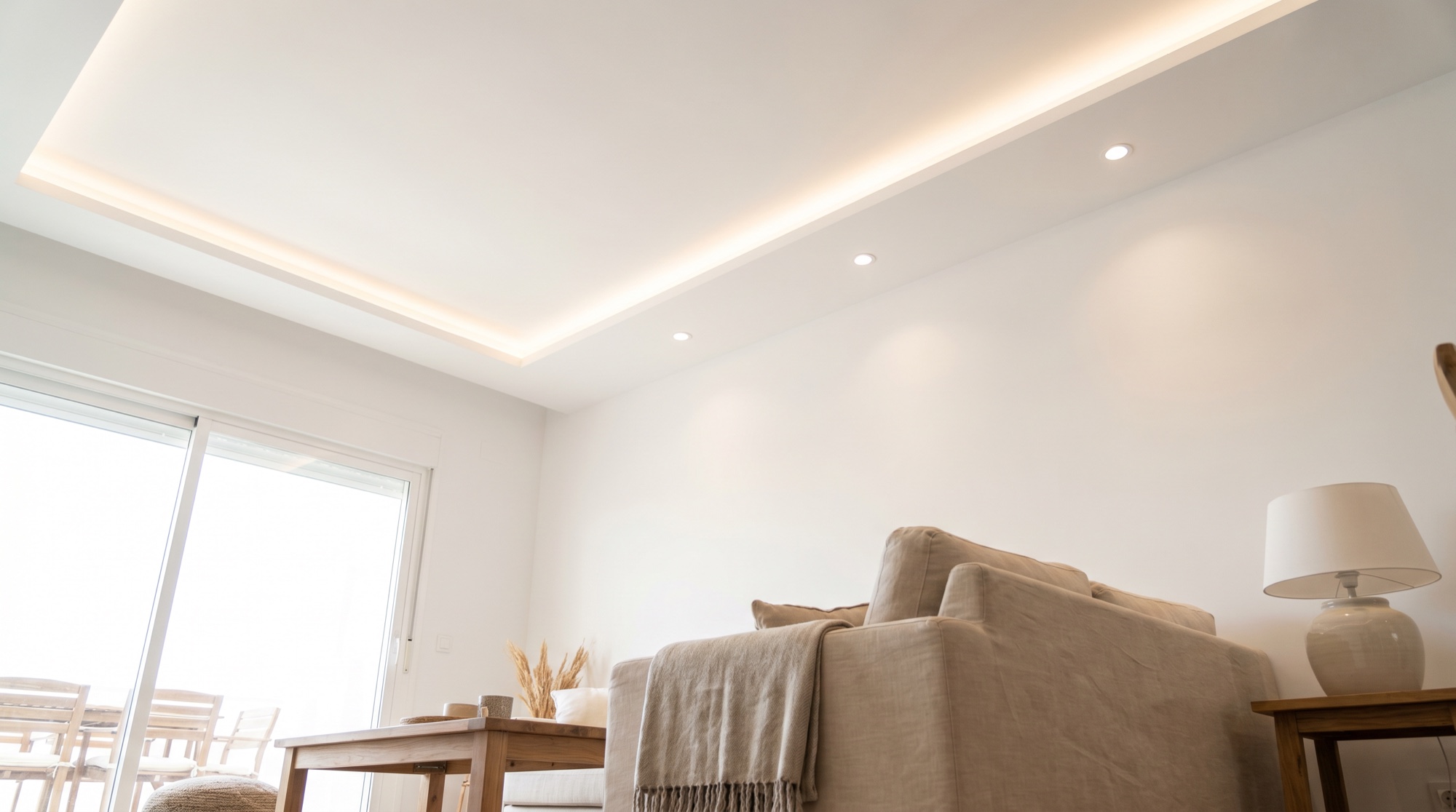
- Ceilings and wall linings: Plasterboard without question. It is the standard system for suspended ceilings, concealing services, and improving façade insulation with minimal loss of space.
- Covered outdoor areas or ground floors with damp issues: Brick. Exposure to the elements or rising ground moisture rules out plasterboard, even in its moisture-resistant form.
When does a professional contractor recommend plasterboard, and when brick?
After years of carrying out full and partial renovations across Cádiz city, Chiclana, El Puerto de Santa María, San Fernando, and Jerez, at Reformas By Bianca we've developed a clear set of criteria for when to use plasterboard and when to use brick. It's not a matter of trends or fashions: it's a technical question that depends on the real conditions of each individual property.
We recommend plasterboard when speed of execution is the priority, when the property is occupied during the renovation, when the floor joists have load limitations (older buildings, loft conversions), when better-than-standard thermal or acoustic insulation is needed, and when the partition won't be exposed to direct moisture or required to carry heavy wall-mounted loads. We also opt for it when the client needs to run new services without chasing into existing walls.
We recommend brick when the partition will carry substantial wall-mounted units, when the space is damp without guaranteed mechanical ventilation, when the property has documented rising damp or water ingress problems, when maximum long-term durability without maintenance is the goal, and on new-build renovations where programme constraints are less pressing. In beachfront properties along the Cádiz coastline or in ground-floor flats in the Pópulo quarter, brick gives us a peace of mind that plasterboard simply cannot match.
Conclusion: quick comparison table and how to get a quote for your partition in Cádiz
If you've made it this far, you now have a clear picture of plasterboard's advantages in renovations and brick's particular strengths. Whether plasterboard or brick is better depends on your specific situation: budget, type of room, damp exposure, programme, and the characteristics of your home in Cádiz. Here's a quick reference summary to keep to hand.
| Criterion | Plasterboard | Brick |
|---|---|---|
| Average price per m² in Cádiz | €35 – 70 | €45 – 80 |
| Installation speed | High (hours) | Medium–low (days) |
| Thermal insulation | Superior with fill | Inferior without cavity |
| Acoustic insulation | Superior with double board | Good with double leaf |
| Damp resistance | Limited (improved with green board) | Naturally high |
| Load on floor joists | Light (25–50 kg/m²) | Heavy (80–120 kg/m²) |
| Ease of running services | Very easy (no chasing) | Chasing required |
| Hanging heavy units | Requires reinforcement or specialist fixings | No issues |
| Site cleanliness | Minimal | Considerable |
| Long-term durability | 30+ years with maintenance | 50+ years without maintenance |
At Reformas By Bianca we provide detailed, no-obligation quotes for your partition project in Cádiz. We visit your property, assess the damp conditions, the state of the floor joists, and your actual requirements, and we recommend the most effective solution, without trying to upsell you on the most expensive option. Get in touch and tell us what you have in mind: we'll help you choose between plasterboard and brick with professional expertise and transparent pricing.