Motorised vs Manual Shutters: Which Should You Choose for Your Renovation in Cádiz?
Motorising your shutters is one of those upgrades that, once you try it, you can't go back. Operating all your shutters with a remote control, programming automatic schedules or integrating them with home automation transforms your daily routine. But it has a cost, and it doesn't always pay off. In this guide we give you all the information to decide whether it's worthwhile in your specific case.
Motorised vs. manual shutter at a glance
Motorised shutter
- One button or remote
- 15-20 years maintenance-free
- Scheduling and smart home
- €300-650 per window
Manual shutter
- Requires manual effort
- Strap: replace every 5-8 years
- No scheduling
- €150-380 per window
How does a motorised shutter work?
A motorised shutter has a tubular motor inside the winding barrel. This motor replaces the strap or crank handle and is operated via a wall switch, remote control or home automation app. Modern motors are quiet (under 45 dB), consume very little energy and have electronic limit switches that prevent the shutter from straining at the stops.
There are two connection types: wired (more reliable, requires a recessed switch connected to the mains) and radio (wireless, easier to install in renovations where you don't want to run new cables). Radio systems also allow centralised control: one remote for all the shutters in the house.
Cost comparison: motorised vs manual per window
| Item | Manual (strap) | Motorised (wired) | Motorised (radio) |
|---|---|---|---|
| New complete shutter (slats + mechanism) | €150–380 | €300–550 | €400–650 |
| Motorise existing shutter | — | €200–280 | €250–350 |
| Full flat (6 windows, new) | €900–2,280 | €1,800–3,300 | €2,400–3,900 |
| Full flat (6 windows, motorise existing) | — | €1,200–1,680 | €1,500–2,100 |
Motor types: which to choose
Not all motors are the same. The motor type determines how the shutter is controlled, the ease of installation and the options for smart home integration. This table helps you choose.
| Motor type | Control | Price per motor | Best for |
|---|---|---|---|
| Wired tubular | Wall switch | €80–140 | Full renovations where walls are already being wired |
| Radio tubular (RF) | Remote + optional wall switch | €120–200 | Partial renovations or motorising existing shutters |
| Solar tubular (with panel) | Remote control | €180–300 | Windows without a nearby power outlet, difficult to wire |
| Smart/WiFi (home automation compatible) | App, voice assistant, scheduling | €150–250 | Smart homes or holiday rental properties |
Overall comparison: motorised vs manual
| Factor | Manual (strap) | Motorised |
|---|---|---|
| Price per window | €150–380 | €300–650 |
| Convenience | Requires manual effort | One button or remote |
| Maintenance | Strap: replacement every 5–8 years | Motor: 15–20 years maintenance-free |
| Mechanism durability | Strap wears and breaks | Motor lasts longer |
| Time scheduling | No | Yes (with timer or home automation) |
| Accessibility | Difficult for elderly people | Full |
Want to motorise your shutters in Cádiz? Request a no-obligation quote.
Cádiz considerations: wind, salt and durability
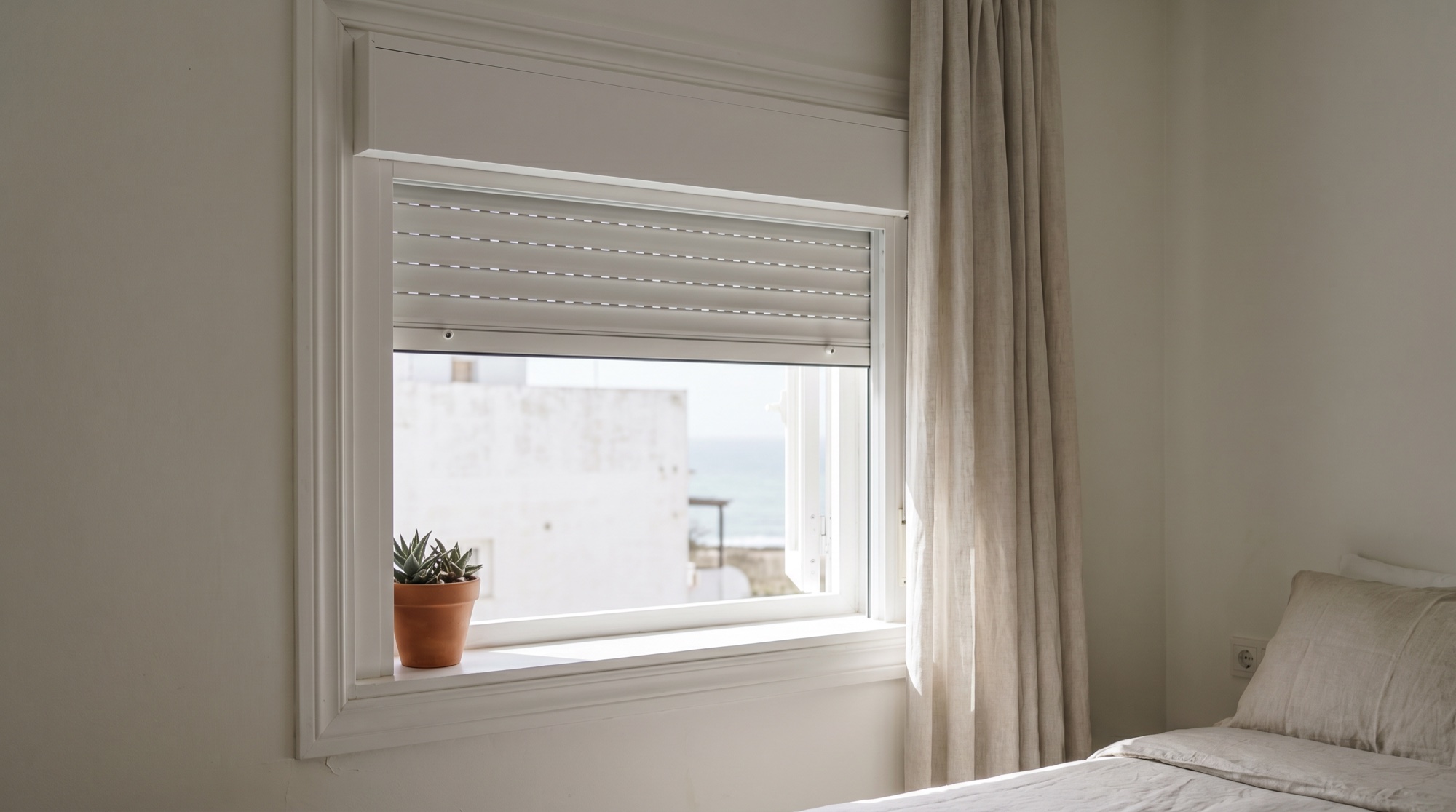
Cádiz has particular climatic conditions that directly affect the choice and durability of motorised shutters. The Levante wind, constant Atlantic humidity and salt spray demand specific precautions.
- Levante wind: on strong Levante days (gusts of 60–80 km/h), motorised shutters with an integrated wind sensor retract automatically to prevent slat damage. This sensor costs €40–80 per motor and is worthwhile in east-facing flats or upper floors.
- Salt and corrosion: in beachfront flats (Paseo Marítimo, La Caleta, Santa María del Mar), salt spray attacks the motor's metal components. Choose motors with a stainless steel casing or anti-corrosion treatment (15–25 % premium). Lifespan increases from 15 to 20+ years.
- Atlantic humidity: average relative humidity in Cádiz exceeds 70 %. Motors with IP44 or higher protection rating withstand conditions better than basic IP20. The price difference is minimal (€10–15 per motor).
- Energy efficiency: programming shutters to close during the hottest hours (14:00–18:00 in summer, coinciding with peak Levante) can reduce the air conditioning bill by 10–15 %, according to IDAE studies.
When is motorisation worthwhile?
- Elderly people or those with limited mobility: motorisation is not a luxury, it is a necessity. The strap requires force and a posture that can be painful or impossible.
- Flats with more than 5 windows: raising and lowering 7–8 shutters manually twice a day (morning and evening) is tedious. With a remote, it's one gesture.
- Renovations where electricians are already on site: the extra cost of wiring the motors is marginal if you are already doing the electrical installation.
- Second homes or holiday rental flats: time scheduling simulates occupancy when the property is empty, improving security.
- High or hard-to-reach windows: in homes with high ceilings in the Cádiz old town, reaching a shutter strap at 2.5 m height is uncomfortable or requires a step stool.
Motorised shutter installation process
- Technical visit: an installer assesses the condition of the box, slats, barrel and nearest power outlet. (30 minutes per property)
- Wiring (for wired motors): cable is run from the shutter box to a recessed wall switch. If the renovation includes electrics, it is integrated with the general wiring. (1–2 hours per window)
- Motor installation: the strap or crank is removed, the tubular motor is fitted inside the existing barrel and connected. (1–1.5 hours per shutter)
- Programming and adjustment: limit switches are set (open and close positions), remotes are paired and schedules programmed if the client requests it. (30 minutes per shutter)
Smart home integration
Motorised shutters with WiFi or Zigbee connectivity integrate with the main home automation ecosystems (Google Home, Alexa, Apple HomeKit, Home Assistant). This allows voice control, automatic scenes and linking with other devices.
- "Good morning" scene: bedroom shutters open gradually at 7:30, kitchen light turns on and coffee machine activates. Cost of integration module: €30–60 per motor.
- Occupancy simulation: shutters move at random times when the property is empty, deterring potential intruders. Especially useful in Cádiz holiday rental flats during the off-season.
- Energy savings: an outdoor temperature sensor closes the shutters automatically when the temperature exceeds 30 °C, reducing the load on the air conditioning.
What if I only want to motorise some shutters?
Perfectly viable and very common. The most popular combination among our clients in Cádiz is to motorise the bedrooms and living room, and leave the kitchen and bathroom with manual straps. Bedrooms are where convenience is most valued (not having to get out of bed to open the shutter in the morning) and the living room usually has larger, heavier windows.
Tip: if you're undecided, ask for the electrical pre-installation (conduit and wiring to the box) to be done at every window, even if you only motorise some now. That way you can add motors in the future without breaking walls. The extra cost of the conduit is just €20–30 per window.