Porcelain vs Ceramic Tiles: Which to Choose for Your Renovation in Cádiz
If you're planning a renovation in Cádiz, one of the first decisions you'll need to make is what type of flooring or wall covering to use. And that's when the question we hear from almost every client comes up: porcelain or ceramic tiles, which is right for me? There's no single answer, because it depends on your budget, the room you're renovating, and the specific conditions of your property. In this guide we walk you through the real differences, with up-to-date prices and recommendations tailored to the climate and particular demands of the Cádiz coastline.
Porcelain vs ceramic: key technical differences
Both porcelain and ceramic tiles are clay-based materials that go through a firing process, but that's roughly where the meaningful similarities end. The difference between the two comes down to the composition of the clay body, the firing temperature, and the resulting porosity. Standard ceramic is fired at between 900 °C and 1,100 °C, whereas porcelain is fired at temperatures above 1,200 °C under significantly higher pressing pressures.
Porcelain vs. ceramic at a glance
Porcelain
- Water absorption < 0.5%
- Hardness 7-8 Mohs, PEI IV-V
- Ideal for floors and outdoors
- Lasts 15-20 years wear-free
Ceramic
- Water absorption 3-10%
- Softer (Mohs 4-6)
- Best for walls
- More affordable option
That process produces a material with very different characteristics. Porcelain has a water absorption rate of less than 0.5%, making it practically impermeable. Ceramic, by contrast, can absorb anywhere between 3% and 10% depending on quality. This distinction matters enormously in wet areas such as bathrooms and kitchens, and even more so in a coastal city like Cádiz, where average ambient humidity hovers around 70–75% for much of the year.
- Porcelain: water absorption < 0.5%, hardness 7–8 on the Mohs scale, flexural strength > 35 N/mm²
- Ceramic: water absorption between 3% and 10%, hardness 4–6 on the Mohs scale, flexural strength between 15 and 25 N/mm²
- Rectified porcelain has precision-cut edges, allowing grout joints of just 1.5–2 mm
- Standard ceramic requires wider joints (3–5 mm) due to the irregularity of its edges
Price comparison: how much does porcelain vs ceramic cost in Cádiz?
Price is, without question, the factor that weighs most heavily for many of our clients, and understandably so, since a renovation is a significant investment. Porcelain tile prices in Cádiz vary according to format, finish, and brand, but the ranges below reflect what we typically work with on our projects. A mid-range ceramic tile costs between €12 and €22/m², while mid-range porcelain sits between €20 and €40/m². If you're looking at large-format rectified porcelain (60×120 or 120×120), prices can rise to €45–65/m² depending on brand and finish.
| Material | Budget range | Mid range | Premium range |
|---|---|---|---|
| Standard ceramic | €8–15/m² | €15–22/m² | €22–30/m² |
| Standard porcelain | €15–22/m² | €22–35/m² | €35–55/m² |
| Rectified porcelain | €25–35/m² | €35–50/m² | €50–80/m² |
| Large-format porcelain | €30–45/m² | €45–65/m² | €65–100+/m² |
Bear in mind that these are material-only prices. The full cost of replacing a floor with porcelain in Cádiz, including labour, substrate preparation, adhesive, and grouting, typically falls between €45 and €90/m² for a full renovation. For ceramic, the complete installed cost is usually €30–55/m². That means for an 80 m² flat, the total difference between choosing ceramic or porcelain can range from €1,200 to €2,800, depending on the ranges selected.
Durability and resilience: which holds up better against the Cádiz coastal climate?
Cádiz has a climate that puts any building material through its paces. The combination of salt-laden humidity, the Levante wind, temperatures that can exceed 35 °C, and sea air heavy with salt creates a particularly harsh environment. We've been carrying out renovations across the province for years and have seen first-hand how each material performs over time.
Porcelain, with its low porosity, stands up far better to prolonged exposure to moisture and salinity. In properties close to the sea, from La Caleta to Chiclana, and across to El Puerto de Santa María, we recommend porcelain without hesitation, particularly for terraces and outdoor areas. Ceramic can develop efflorescence (white staining caused by salt migration) in as little as 3–4 years when installed in areas exposed to sea breeze. Porcelain, under the same conditions, retains its original appearance for over 15 years with minimal upkeep.
When it comes to wear resistance, the PEI rating is the standard reference. High-traffic areas require at least PEI IV. Most mid-to-high quality porcelain tiles already come rated PEI IV or V, whereas many budget ceramics only reach PEI III, perfectly adequate for walls but insufficient for frequently used floors. If you're considering ceramic or stoneware for flooring, this classification is decisive.
Porcelain or ceramic for the bathroom: which delivers better results?
The bathroom is probably the room where the choice of material has the greatest long-term impact. Constant exposure to water, steam, and cleaning products demands a material that is not only hardwearing, but also easy to maintain. If you're wondering what the best bathroom flooring is for a property in Cádiz, our professional answer is clear: porcelain for the floor and, budget permitting, for the walls too.
Porcelain in the bathroom offers several decisive advantages. Its near-total impermeability prevents the growth of mould and fungi through moisture absorption, a very common problem in bathrooms in older properties in Cádiz's historic centre, where ventilation is often limited. Anti-slip finishes (Class C to DIN 51097) also ensure safety even on a wet floor. With rectified porcelain you can achieve minimal grout lines that reduce dirt build-up and make cleaning much easier.
That said, ceramic remains a perfectly valid option for bathroom walls if you need to keep costs down. On walls, direct water exposure is lower, and glazed ceramic performs its decorative and protective function perfectly well. A smart approach we often recommend is to combine porcelain on the floor and shower area with glazed ceramic on the remaining walls, you get an excellent result while cutting the overall cost by 15–20%.
Practical tip: If you're renovating a bathroom in a property near the sea in Cádiz, invest in porcelain with a Class B or C anti-slip finish for the shower floor. The salt that drifts in with the sea breeze settles on surfaces and can make smooth floors slippery. A porcelain tile with a textured surface prevents accidents and also does a much better job of disguising the limescale marks left by Cádiz's hard water.
Not sure which flooring to choose? Get in touch and we'll help you pick the perfect material for your renovation.
Porcelain or ceramic for the kitchen: stain and moisture resistance
The kitchen is the other critical room where the choice between porcelain and ceramic can make a noticeable difference to your daily life. Kitchen floors and splashbacks are exposed to grease splashes, acids (lemon, vinegar, tomato), impacts from heavy objects, and sharp temperature changes. Porcelain (especially through-body coloured porcelain) stands up to all of these without deteriorating.
For kitchen floors, porcelain is the safest choice. Its stain resistance is far superior: splashes of oil, wine, or coffee wipe away cleanly even hours later. On a porous ceramic tile, those same stains can penetrate the surface if they're not cleaned up immediately. For the splashback between the worktop and wall units, glazed ceramic works perfectly well because contact with liquids is brief and cleaning is immediate.
One thing many clients aren't aware of is impact resistance. In the kitchen, it's common for pans, plates, or tins to be dropped. Good-quality porcelain (minimum 9 mm thick) will withstand these impacts without cracking in most cases. Ceramic, being softer and more porous, tends to chip with moderate impacts, particularly at the edges of tiles.
Which is best for living room floors and hallways?
For living room floors and high-traffic areas such as hallways and entrance halls, the decision between ceramic and porcelain becomes particularly significant because we're talking about large surface areas, and that's where the per-square-metre price difference really adds up. In a 25 m² living room plus an 8 m² hallway, the difference between ceramic and porcelain can exceed €500–800 on materials alone.
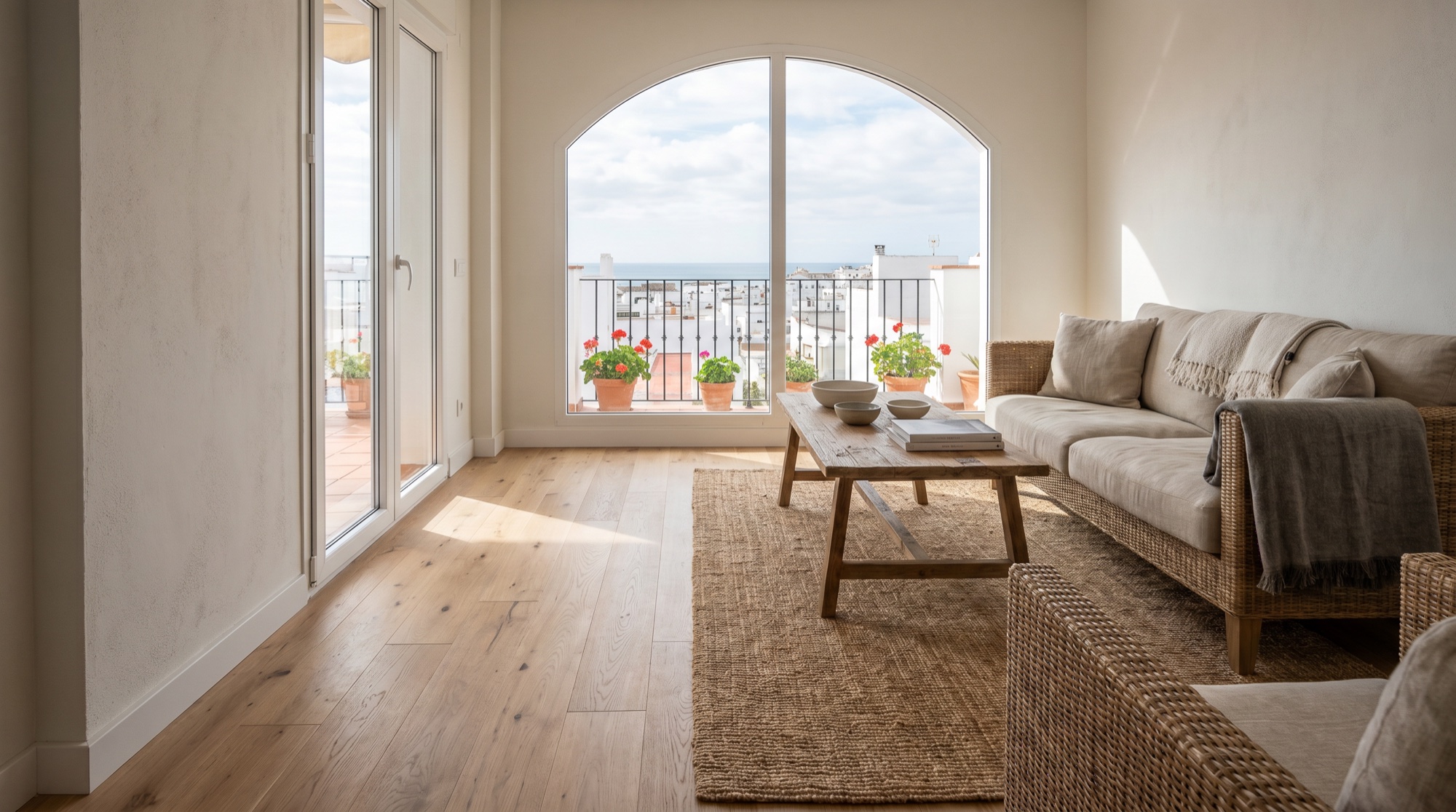
Our recommendation for living rooms and hallways is porcelain whenever the budget allows. Large formats (60×60 or 60×120) with a matt or semi-polished finish create a sense of space and visual continuity that completely transforms the feel of a home. With fewer grout lines, maintenance is simpler and the aesthetic result is clearly superior. Large-format porcelain in wood, concrete, or natural stone effects is currently the most popular trend we see in renovation projects across Cádiz.
If the budget is tight, a mid-range ceramic with a PEI IV rating can deliver an acceptable result in moderately trafficked hallways. But bear in mind that in a family home with children or pets, a budget ceramic can show visible wear in the busiest areas in as little as 5–7 years. A mid-range porcelain under the same conditions will hold its appearance for 15–20 years without issue.
Fitting and installation: price differences and technical complexity
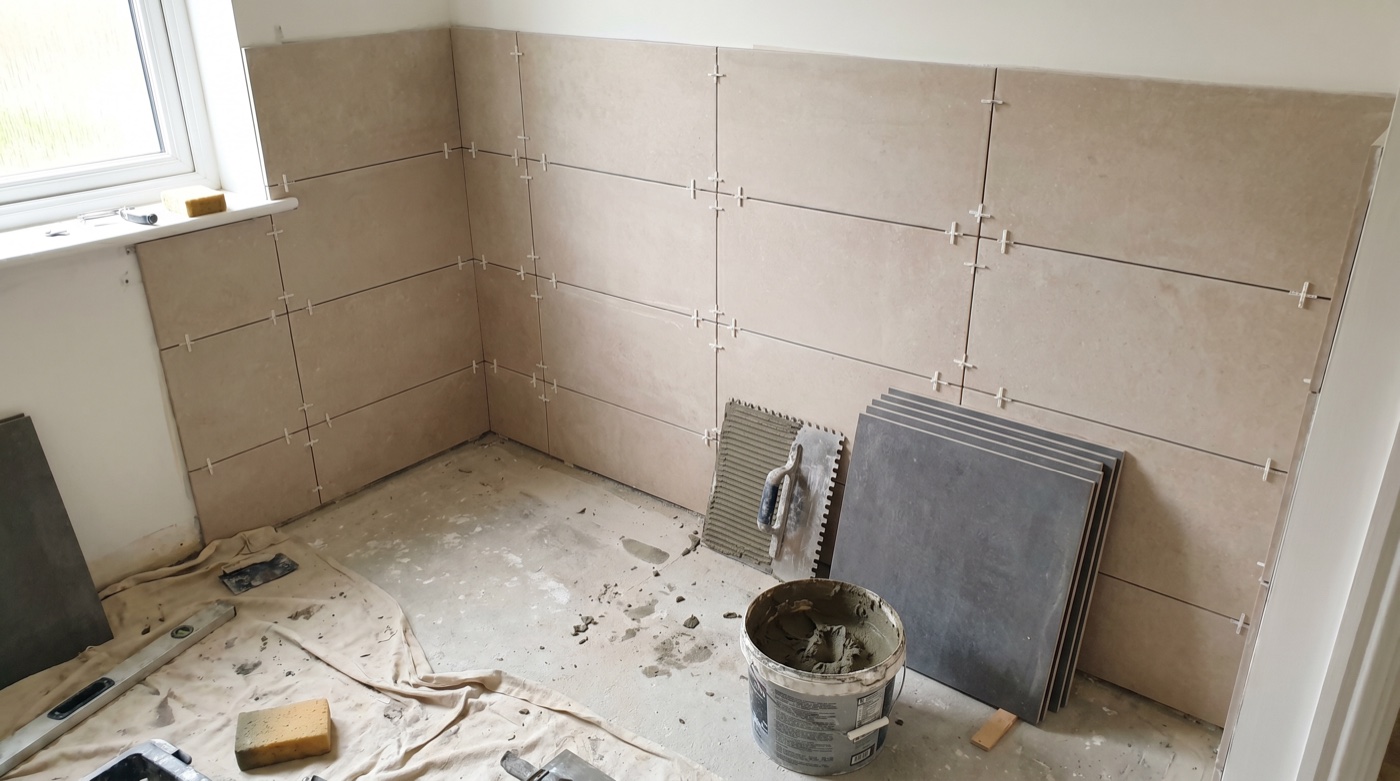
Installation is another area where the difference between porcelain and ceramic makes itself felt, both in cost and technical complexity. Porcelain, being harder and denser, requires specific cutting tools (diamond-blade wet saws rather than the manual tile cutters that suffice for ceramic) and a higher-quality adhesive. Standard C1 tile adhesive is adequate for ceramic in interior settings, but porcelain requires a deformable C2 TE or C2 TES adhesive, especially in large formats.
Labour costs also differ. In Cádiz, laying standard-format ceramic (30×30 or 45×45) is typically charged at €14–20/m², while fitting medium-format porcelain (60×60) ranges from €18 to €28/m². For large-format porcelain (60×120 or larger), installation can cost €25–38/m² because it requires more labour (usually two tilers) double-buttering with adhesive, and greater precision in levelling.
| Cost element | Standard ceramic | Medium porcelain | Large-format porcelain |
|---|---|---|---|
| Labour (laying) | €14–20/m² | €18–28/m² | €25–38/m² |
| Adhesive (tile cement) | C1: €4–6/m² | C2 TE: €6–9/m² | C2 TES: €8–12/m² |
| Grouting | €2–3/m² | €3–4/m² | €3–5/m² |
| Removal of existing floor | €6–10/m² | €6–10/m² | €6–10/m² |
| Estimated time (70 m² flat) | 4–5 days | 5–7 days | 7–10 days |
Bear in mind that if the renovation includes removing the existing floor and levelling the substrate, costs will increase by a further €6–15/m² regardless of the material chosen. When clients ask us what flooring to go for, we always advise looking at the total project cost rather than just the price of the material, because installation can account for between 40% and 55% of the overall flooring budget.
Final recommendation: when to choose porcelain and when to choose ceramic
After years of carrying out renovations in Cádiz and the surrounding province, our recommendation is based on a straightforward logic: invest more where it matters most, and save where you can without compromising the result. If you're still weighing up porcelain against ceramic, here's our professional take in brief.
- Choose porcelain for: all floors throughout the property if budget allows, complete bathrooms (floor and shower area), kitchens, terraces, outdoor areas, and any room in a property close to the sea
- Choose ceramic for: bathroom walls outside the shower zone, decorative kitchen splashbacks, secondary rooms with light footfall where you need to trim costs, and wall coverings generally
- Combine both to: optimise your budget without sacrificing quality where it counts most, porcelain on floors and wet areas, ceramic on walls and vertical surfaces
- Avoid budget ceramic for: floors in high-traffic areas, outdoor surfaces, and any horizontal surface subject to constant moisture or heavy use
At Reformas By Bianca we work with the leading tile and porcelain distributors in the province of Cádiz, which means we can offer competitive prices on materials from top brands. We handle the entire process from start to finish: personalised advice, measurements, a detailed quote, supply of materials, installation, and final clean-up. If you're thinking about renovating your home and would like help choosing the right material for each room, get in touch with no obligation. We'll visit, assess your specific situation, and put together a quote tailored to your needs and your budget.