Types of Interior Doors: Which to Choose for Your Renovation in Cádiz
Changing the interior doors in a flat is one of those decisions that seems straightforward until you actually start looking. Suddenly you're drowning in options: hinged, sliding, folding, solid wood, lacquered MDF, glass, and every supplier is pushing you in a different direction. At Reformas By Bianca we've been fitting interior doors in Cádiz for years, and we know the secret isn't finding the most expensive door, it's finding the one that suits your space, your lifestyle and your budget. This guide gives you everything you need to make a well-informed decision.
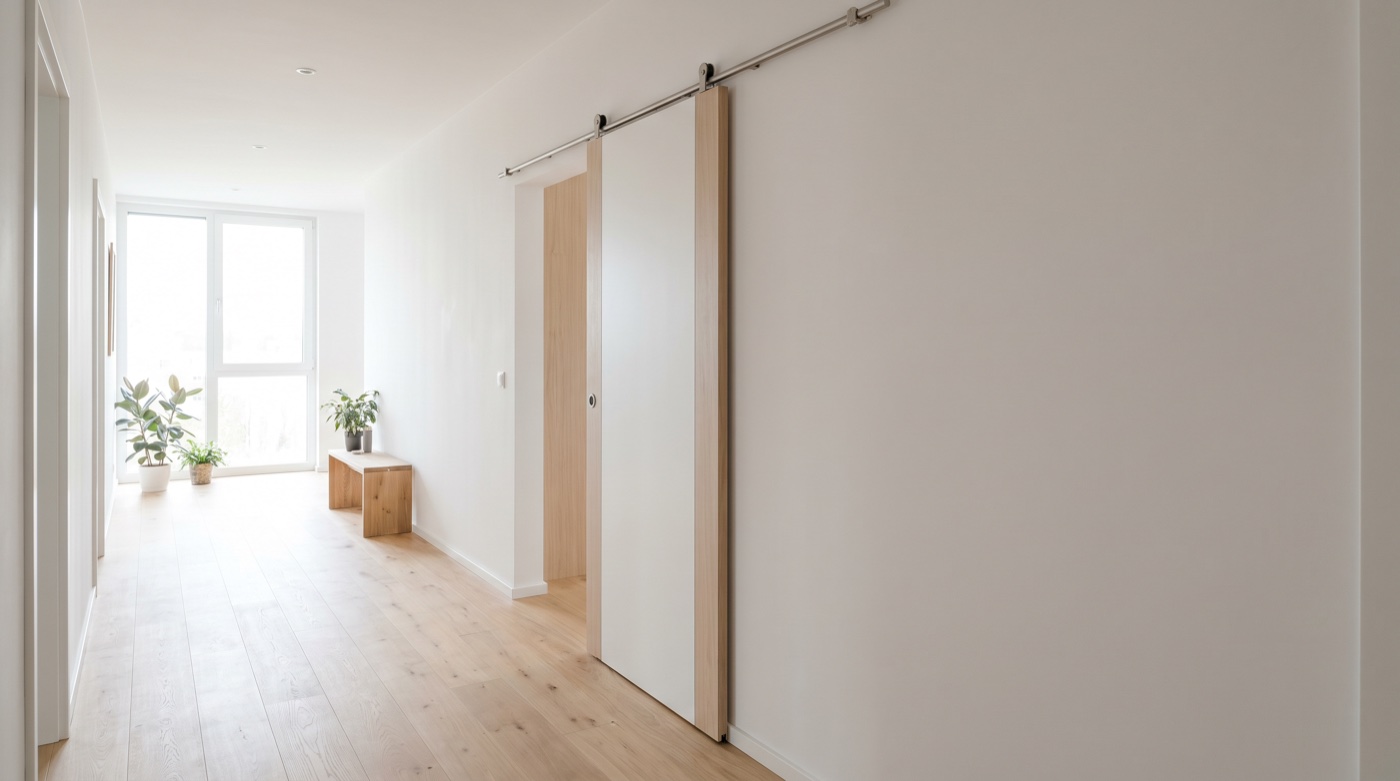
Types of interior door: the full picture
Interior doors are classified mainly by their opening mechanism and the material they're made from. Before you fall in love with a finish or a colour, it's worth understanding how each system works, because that determines how much space you need, how much sound insulation you get, and how much you'll pay. In today's Spanish market there are four main opening families: hinged, sliding, folding and pivot.
- Hinged: the classic side-hung door. It swings on a hinge and needs a clear radius to open fully.
- Sliding: runs parallel to the wall, either on a visible surface-mounted track or concealed inside the partition wall.
- Folding: made up of two or more articulated panels that fold back on themselves like an accordion.
- Pivot: rotates on a central or offset axis, creating a striking, contemporary visual effect.
Each system has its own variations. A sliding door can run on a top-mounted surface track, be recessed into a metal cassette system (such as Scrigno or Eclisse), or even run at an angle to divide two areas. Hinged doors can be single-leaf, double-leaf or fitted with a fixed side panel. Knowing your options means you won't simply go with the first thing a materials supplier suggests. When we take on a full renovation in Cádiz, we always put forward at least two alternatives per room so you can compare them in context.
Hinged vs sliding doors: pros and cons
The hinged-versus-sliding debate is the most common one in any renovation. Hinged doors still dominate the market because they're the most affordable option, the easiest to install, and the best for sound insulation when fitted with a good perimeter draught seal. Their main drawback is space: a standard 72.5 cm door needs nearly a square metre of clear floor to open fully, and in flats in central Cádiz (where every square metre counts) that can be a real problem.
Hinged vs. sliding door at a glance
Hinged door
- The most affordable
- Best sound insulation
- No structural work
- Needs ~1 m² to open
Sliding door
- No swing space needed
- Ideal for small flats
- Pocket type needs building work
- Lower sound insulation
A sliding door solves that problem entirely. By running parallel to the wall it frees up the full swing area. Pocket sliding doors are completely hidden inside the partition and give an immaculate finish, but they require building work: you need to open up the wall, fit the metal cassette and re-plaster. On a full renovation this doesn't add much to the cost because the walls are already being touched up; in an occupied flat where you only want to swap the doors, the structural work can push the budget up sharply. Surface-mounted barn-style sliders are a middle-ground option: no partition work needed, they bring a very current industrial or rustic feel, and they can be fitted in half a day.
| Feature | Hinged door | Pocket sliding door | Surface-mounted sliding door |
|---|---|---|---|
| Space required | Full swing radius (~1 m²) | None | Free wall space alongside (~1.5 m) |
| Sound insulation | High (with draught seal) | Medium | Low |
| Average installed cost (Cádiz) | €180 – €350 | €450 – €900 | €300 – €550 |
| Structural work needed | No (frame only) | Yes (open partition) | No |
| Installation time | 2 – 3 hours | 1 – 2 days | 3 – 5 hours |
| Aesthetic | Classic / versatile | Minimalist / clean | Industrial / contemporary |
Our general recommendation: if you're doing a full flat renovation, take the opportunity to fit pocket sliding doors in bathrooms, dressing rooms and kitchens. If you're only replacing the doors without touching the walls, hinged doors with a quality lacquered finish still offer the best value for money. And if you want something with a bit more character, barn-style surface-mounted sliders work brilliantly in living rooms and bedrooms.
Folding and pivot doors: when do they make sense?
Folding doors are a smart solution for tight spaces where neither a hinged nor a sliding door will work. Think of a built-in wardrobe tucked against a corner, a narrow utility room, or a pantry entrance where there's no wall space for a slider and no room to swing a hinged door. A folding door folds back on itself using just 15–20 cm of depth. Its weak points are the durability of the articulated hinges and lower sound insulation, which is why we tend to recommend them for utility areas and storage rather than bedrooms.
Pivot doors are a different proposition altogether. They rotate on an axis that's not at the edge but offset from it, creating a dramatic sweep that divides a space visually without fully closing it off. They're a staple of high-end interior design projects, lofts and commercial premises. In Cádiz homes we've fitted them to separate the sitting and dining areas in renovations of spacious flats in the historic centre, where high ceilings and generous proportions really show them off. They come at a considerably higher price, a floor-to-ceiling pivot door in lacquered MDF can come to more than €1,500 installed, and they require specialist hardware capable of supporting the weight of the panel.
Practical tip: before ruling out folding doors on aesthetic grounds, look at full-panel models (without louvres or slats). Today's manufacturers offer smooth lacquered folding doors that, when closed, look just like a conventional door. They're ideal for hiding the washing machine and tumble dryer in smaller Cádiz flats where every centimetre matters.
Want to renew your interior doors? We'll advise on materials and finishes. Free quote.
The most common materials: solid wood, lacquered MDF, PVC and glass
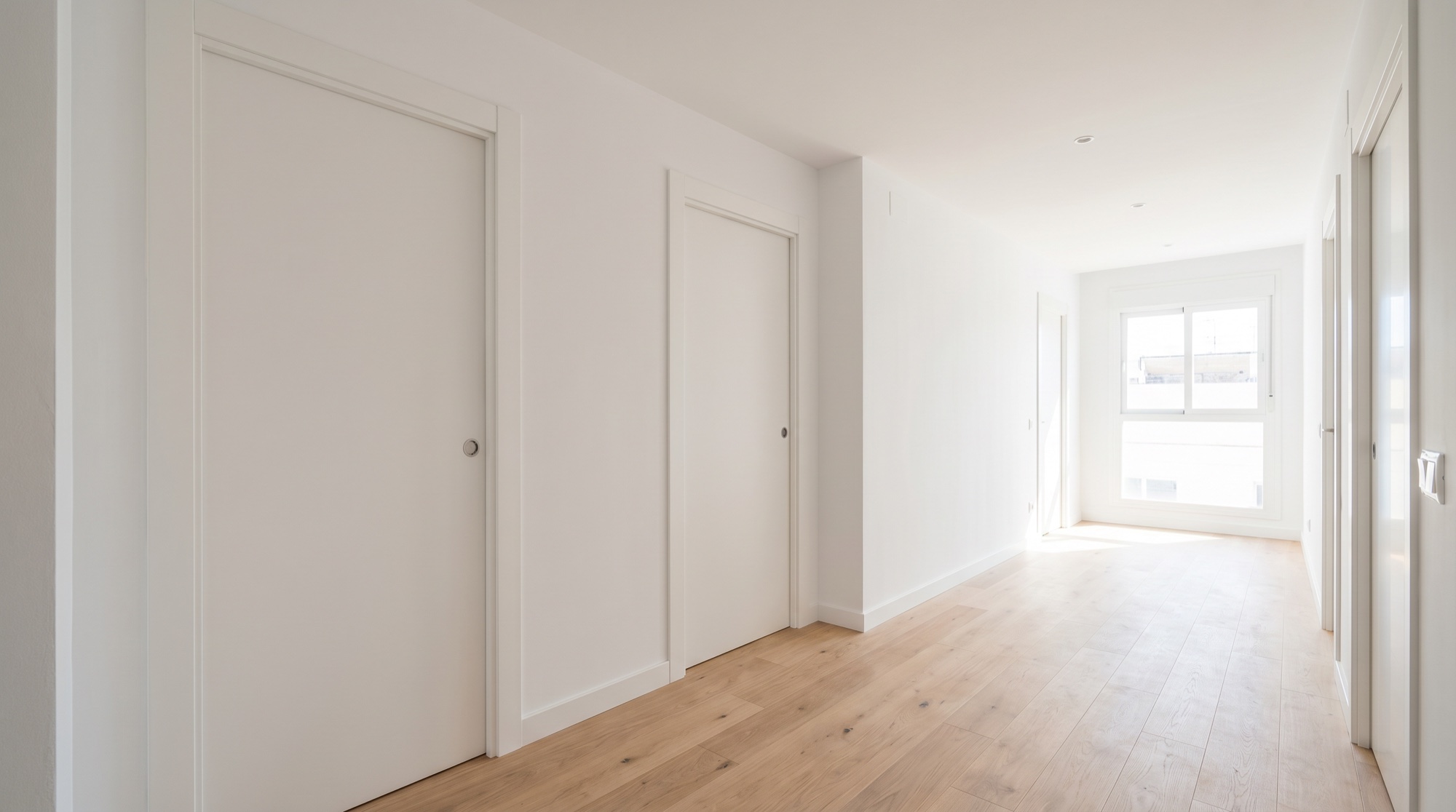
The material affects the feel, the weight, the insulation and, of course, the price. In the renovations we carry out in Cádiz, four materials account for around 95% of all installations: solid wood, lacquered medium-density fibreboard (MDF), PVC and glass. Each has its place, and getting this wrong is one of the most costly mistakes you can make.
Solid wood (pine, oak or beech) is the premium material par excellence. It offers the best acoustic and thermal insulation, an unmatched sense of solidity, and a lifespan that can exceed 30 years with minimal upkeep. The downsides are the price (an oak door starts at €400–€500 for the panel alone) and its sensitivity to moisture, which matters in the coastal areas of Cádiz where the salt air can warp untreated wood. We always recommend a closed-pore varnish or lacquered finish to protect it from the local climate.
Lacquered MDF dominates the modern interior door market in Cádiz, and rightly so. It's a medium-density fibreboard panel coated with multiple layers of lacquer, giving a smooth, uniform finish available in any RAL colour. It's more affordable than solid wood, more stable in humid conditions and practically maintenance-free. The difference between a quality lacquered MDF door and a cheap one lies in the number of lacquer coats and the thickness of the board: always look for panels of at least 40 mm with a minimum of three coats of lacquer to prevent yellowing or flaking within a few years.
| Material | Panel price (€) | Sound insulation | Moisture resistance | Maintenance | Estimated lifespan |
|---|---|---|---|---|---|
| Solid wood (oak) | €400 – €700 | Excellent | Medium (needs treatment) | Medium | 25 – 40 years |
| Lacquered MDF (mid-to-high quality) | €150 – €350 | Good | High | Low | 15 – 25 years |
| PVC | €80 – €180 | Fair | Very high | Very low | 10 – 20 years |
| Toughened glass | €250 – €600 | Low | Total | Low | 20+ years |
PVC is the budget option for wet areas such as bathrooms and utility rooms. It won't rot, won't swell, and wipes clean with a damp cloth. The downside is feel: a PVC door simply doesn't convey the same quality as wood or lacquered MDF, and the available designs are more limited. Toughened glass, on the other hand, is ideal for dividing spaces without sacrificing light, particularly useful in open-plan kitchen-living areas or home offices. It can be clear, translucent, frosted or screen-printed, and for safety must always be toughened or laminated.
How to choose the right door for each room
Not every door in your home needs to be identical. In fact, when people ask us which type of interior door to go for, our first answer is always: it depends on the room. A bedroom needs sound insulation, a bathroom needs moisture resistance, and a living room needs visual openness. Going with the same door throughout is convenient, but it's rarely the best solution.
- Bedrooms: prioritise sound insulation. A hinged door in lacquered MDF or solid wood with a perimeter draught seal. Minimum 40 mm thickness.
- Bathrooms: moisture resistance above all else. A pocket sliding door if there's enough space in the partition (it frees up precious floor area in small bathrooms) or a hinged door in moisture-resistant lacquered MDF. Avoid untreated solid wood.
- Kitchen: if you want to contain cooking smells while keeping the light flowing, go for a sliding door in translucent toughened glass. In an open-plan kitchen-living space, a large pivot or sliding door can work as an occasional divider.
- Living room and hallways: surface-mounted sliders or double-leaf hinged doors to give a sense of space. Contemporary interior doors in Cádiz with flat finishes and integrated handles deliver a clean, modern look.
- Dressing rooms and pantries: folding or sliding doors. Insulation isn't the priority here, easy access and not losing usable space is.
- Utility rooms: a folding door in PVC or moisture-resistant MDF. This is the most punishing area for humidity and the place where it makes the least sense to invest in premium materials.
One trick we use in many renovations: keep the same external finish on all the doors so the hallway has visual coherence, but vary the opening system and internal material to suit each room's requirements. That way you get the functionality you need without compromising on aesthetics. It's the smartest way to replace the interior doors in a flat without it looking like a showroom catalogue.
Installation costs for interior doors in Cádiz
Let's talk real figures. The cost of interior doors in Cádiz varies considerably depending on the material, the opening system and whether any building work is required. The ranges below include the door, the frame or cassette, the handle, professional installation and final adjustment. They do not include wall painting or plastering finishes if partition walls need to be opened.
| Door type | Installed price range (€) | What's included |
|---|---|---|
| Hinged lacquered MDF (standard) | €180 – €350 | Panel, frame, architrave, handle, installation |
| Hinged solid wood (oak/beech) | €500 – €900 | Solid panel, frame, architrave, premium handle, installation |
| Pocket sliding door, lacquered MDF | €450 – €900 | Panel, metal cassette, tracks, basic structural work, installation |
| Surface-mounted barn-style sliding door | €300 – €550 | Panel, surface track, hardware, installation |
| Folding lacquered MDF | €250 – €450 | Articulated panels, track, hardware, installation |
| Floor-to-ceiling pivot door, lacquered MDF | €1,200 – €2,000 | Large-format panel, pivot hardware, installation |
| Toughened glass sliding door | €600 – €1,200 | Glass panel, track/cassette, hardware, installation |
For a typical three-bedroom flat with one main bathroom, a cloakroom and a kitchen (roughly six doors in total) the budget we typically work with at Reformas By Bianca runs from €1,500 to €3,500 using mid-to-high quality lacquered MDF doors. If you opt for solid wood throughout, the budget can easily exceed €5,000. One piece of advice: spend more on the doors people see (bedrooms, living room) and save on the ones they don't (utility room, pantry). The end result will look just as polished at a significantly lower overall cost.
The installation timeline for a complete flat in Cádiz is typically one to three days for standard hinged doors, and three to five days if pocket sliding doors requiring structural work are involved. Doors are made to order and the lead time from the factory ranges from three to six weeks, something worth factoring into your renovation schedule to avoid any nasty surprises.
Common mistakes when choosing interior doors and how to avoid them
After hundreds of installations across the province of Cádiz, we've seen the same mistakes crop up again and again. Here are the most common ones so you don't fall into the same traps.
- Choosing on looks without measuring: a beautiful door that doesn't fit the opening, or that swings into a piece of furniture, is an expensive problem. Always measure the opening, the swing radius and the clearance from any obstacles before deciding on the opening system.
- Skimping on the handle: the handle is something you touch 20 times a day. A cheap zamak handle will loosen within months and undermine the whole quality feel. Invest in stainless steel or brass handles; the difference is €15–€30 per door and you'll notice it every single day.
- Ignoring moisture in a coastal location: Cádiz has an average relative humidity of 70–75%. Untreated wood swells, warps and stops closing properly. Always insist on protective finishes, or choose moisture-resistant MDF for wet areas.
- Not thinking about which way the door opens: during renovations, layouts often change but the original swing direction gets kept by default. Check that the door opens the right way and doesn't block light switches, sockets or radiators.
- Buying doors online without seeing samples: screen colours never match reality. An off-white can look yellow next to pure white walls. Always ask for a physical finish sample before confirming your order.
- Overlooking sound insulation in bedrooms: a hollow-core budget door lets every sound through. If you share a flat or have children, the extra cost of a solid-core door with a draught seal will pay for itself in peaceful nights' sleep.
With interior door joinery in Cádiz, as with most things, cheap tends to cost more in the long run. It's not about spending a fortune, it's about investing wisely: quality materials where they matter, opening systems tailored to each space, and professional installation that guarantees the result. If you'd like personalised advice for your renovation, the team at Reformas By Bianca is on hand to help you choose, measure and fit exactly the right doors for your home.