Steps to Renovate a Flat in Cádiz: Step-by-Step Guide from Project to Handover
Renovating a flat in Cádiz is one of the best decisions you can make, whether you're looking to bring a period property in the old town up to date, modernise a flat in Extramuros, or add value to something in the Bahía area. Without a clear plan, though, what starts as an exciting project can quickly turn into a headache, full of delays, cost overruns and unwelcome surprises. At Reformas By Bianca we've spent years guiding clients through every stage of the full renovation process in Cádiz, and we've learnt that the key is following a logical sequence right from the outset. This guide walks you through, step by step, how to organise a renovation in Cádiz so you end up with the flat you had in mind, on budget and on schedule.
Where do you begin? Planning and defining the scope of the renovation
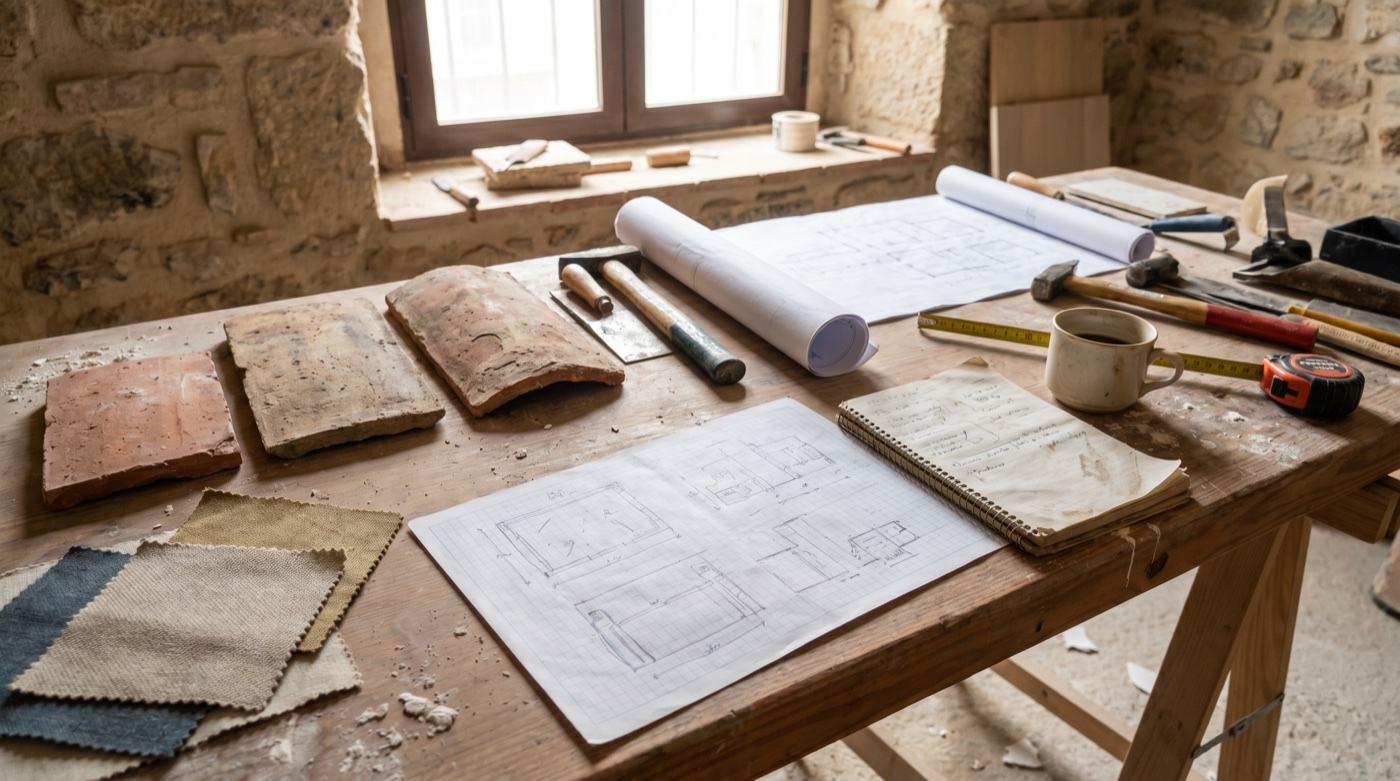
Before you get in touch with any tradesperson or contractor, the first thing to do is work out exactly what you want to achieve. Updating a bathroom and kitchen is a very different undertaking from a full renovation that involves reconfiguring the layout, rewiring, replumbing and replacing all the finishes throughout. Take a few days to walk through the flat calmly, note down everything that isn't working and everything you'd like to change, then set clear priorities: what's essential, what would be nice to have, and what can wait.
Many flats in Cádiz have characteristics particular to traditional local construction: load-bearing walls of ostionera stone, high ceilings with timber beams, asbestos-cement downpipes and old window frames that offer no protection against the levante wind. Identifying these features early on is crucial, as they directly affect the scope of the work and the budget. A flat from the 1960s on Calle Ancha will require very different interventions from a 1990s flat near Puerta Tierra or a terraced house in San Fernando.
Our recommendation is that before you start requesting quotes, you put together a document with three things: a prioritised list of requirements, photographs of the current state of each room, and an upper budget limit you're prepared to spend. With that in hand, any reputable company will be able to give you a realistic proposal, and you'll avoid wasting weeks comparing quotes that aren't actually comparing like for like.
Practical tip: before knocking down a partition wall or altering the layout, check whether your residents' association requires consent for works affecting shared elements. In older buildings in central Cádiz, many walls that look like simple partitions are in fact load-bearing. A qualified structural engineer or architect can confirm this in a site visit of under an hour.
Budget and finance: how much to set aside before you start
What it costs to renovate a flat in Cádiz depends on the type of work, the quality of materials and the condition of the property to begin with. As a current reference, a full renovation of an 80 m² flat in Cádiz typically falls between €40,000 and €70,000 at mid-range specification, including new services, bathroom, kitchen and flooring throughout. If you only need a partial renovation (bathroom and kitchen, say) you're looking at €12,000 to €22,000. For cosmetic work such as painting, vinyl flooring and minor repairs, the range drops to €5,000–€10,000.
| Type of renovation | Indicative price (80 m² flat) | Estimated duration |
|---|---|---|
| Cosmetic (paint, flooring, minor details) | €5,000 – €10,000 | 2 – 3 weeks |
| Partial (bathroom + kitchen) | €12,000 – €22,000 | 4 – 6 weeks |
| Full renovation, mid-range | €40,000 – €70,000 | 8 – 14 weeks |
| Full renovation, high-end with design | €70,000 – €110,000 | 12 – 20 weeks |
| Structural refurbishment (historic building) | From €80,000 | 16 – 30 weeks |
One of the most common mistakes is budgeting to the exact figure with no contingency. In older Cádiz flats, particularly in the old town, it's common to uncover hidden damp, aluminium wiring that needs replacing, or deteriorated downpipes that only come to light once demolition begins. Always set aside an additional 10–15% on top of the construction budget as a safety buffer. If you don't need it, all the better, but if something does come up, you won't have to halt the works while you search for extra funding.
On the financing side, most banks in Cádiz offer home improvement loans at rates of between 5% and 8% APR over terms of five to ten years. Another worthwhile option is to look into the Plan Vive grants in Andalusia or the housing rehabilitation subsidies from Cádiz City Council, which can cover part of the cost for energy efficiency or accessibility improvements.
Planning permission and building licences in Cádiz: when you need them and how to apply
Not every renovation requires planning permission, but far more do than most people assume. Cádiz City Council classifies building works into two main categories: a responsible declaration (minor works) and a major works licence. A responsible declaration covers work such as replacing flooring, tiling, swapping out sanitaryware, painting or changing internal doors. It can be submitted online or in person at the Planning Department (Gerencia de Urbanismo) and allows works to begin almost immediately.
However, if your renovation involves reconfiguring the internal layout, touching structural elements, altering the facade or modifying gas installations, you will need a major works licence with a technical project signed off by an architect and stamped by the relevant professional body. The approval process can take between four and eight weeks, so it's essential to apply well in advance. If your flat falls within the Special Protection Plan for Cádiz's Historic Centre (PEPCH), the requirements are even more stringent and a report from the Heritage Commission may be required.
- Responsible declaration: works with no structural impact. Cost: municipal fees of €50 to €200. Works may begin immediately after submission.
- Major works licence: technical project required. Cost: architect's fees (€1,500 – €4,000 depending on scope) plus municipal fees (1–3% of the estimated construction cost). Approval timeline: 4–8 weeks.
- Historic centre (PEPCH): additional Heritage Commission report required. May add 2–4 weeks to the overall timeline.
- Public highway occupation: if you need a skip or scaffolding on the street, apply for the occupation permit at least 10 days in advance.
We always handle all permit and licence administration on behalf of our clients, because we know that a single administrative error can bring a project to a standstill for weeks. It's part of the full service we offer at Reformas By Bianca, and it means you can focus on the design decisions while we deal with the paperwork.
The correct order of trades: demolition, services, masonry, finishes
One of the questions we hear most often from clients is what to tackle first in a flat renovation. The sequencing of trades isn't arbitrary, each phase depends on the one before it, and disrupting the order causes delays, additional costs and technical problems. Here is the correct sequence for a flat renovation in Cádiz.
The correct order of trades
- 1Protection and demolitionProtecting what stays and demolishing partitions, floors and old fittings.
- 2ServicesMultilayer plumbing, wiring to regulations and ducting, chased in before closing walls.
- 3Masonry and partitionsNew partitions, screeds, render and surface prep.
- 4Waterproofing and tilingWaterproofing showers and terraces; laying floors and wall tiles.
- 5JoineryInternal doors, fitted wardrobes, windows and balustrades.
- 6Painting and snaggingPaint, accessories, taps, final sanitaryware, clean and snagging.
- Phase 1, Protection and demolition: areas not being touched are protected (floors, doors, windows), and demolition of partition walls, floor removal, and stripping out of old sanitaryware and fittings takes place. Rubble is removed by licensed skip.
- Phase 2, Services: plumbing (new PEX or multilayer pipework), electrics (new consumer unit, copper wiring to current regulations), telecoms and, where applicable, air conditioning ductwork. All of this is chased into the walls before they are closed up.
- Phase 3, Structural work and partitions: new partition walls are built in brick or plasterboard, floor screeds are laid, render is applied, and surfaces are prepared for finishes.
- Phase 4, Waterproofing and insulation: essential for shower trays, balconies and terraces. In Cádiz, with the coastal humidity, this step cannot be skipped.
- Phase 5, Flooring and tiling: laying of floor coverings (porcelain, stone, vinyl) and ceramic wall tiles in bathrooms and kitchen.
- Phase 6, Joinery and ironmongery: fitting of internal doors, built-in wardrobes, windows (if being replaced) and balustrades.
- Phase 7, Painting and finishing: plastering of walls, painting, fitting of skirting boards, electrical accessories (sockets, switches), taps and final sanitaryware.
- Phase 8, Final clean and snagging: professional post-construction clean and a thorough check of every detail before handover.
Following these phases is what separates a renovation that runs smoothly from one that drags on indefinitely. Laying the floor before the services are complete, for example, means lifting tiles to run a forgotten pipe, multiplying both cost and time. At Reformas By Bianca we coordinate all the trades so that each specialist arrives at precisely the right moment.
Ready to take the first step on your renovation? Request a free quote and we'll guide you through every phase.
How to coordinate tradespeople and keep on top of progress without losing your mind
Coordinating plumbers, electricians, builders, painters, carpenters and materials suppliers is, without question, the most stressful part of any renovation if you're managing it yourself. Each trade works at its own pace, and if one falls behind, the knock-on effect can push the entire schedule back. Our advice, if you decide to manage the renovation yourself, is to appoint a single point of contact on site (a site manager or foreperson) who is responsible for coordinating the arrival and departure of each tradesperson.
If you hire a full renovation company like ours, that coordination is included as part of the service. We assign a dedicated site manager to every project who visits the flat several times a week, monitors each trade's progress, resolves issues as they arise and sends you regular updates with photos of how things are coming along. That way you can get on with your life without having to check your phone every hour.
Something we always recommend is drawing up a week-by-week project programme from day one. This document sets out which trade is working each week, which materials need to be on site and what decisions the client needs to make at each stage. It is the single most effective tool for keeping a renovation in Cádiz on track rather than descending into chaos.
Materials and design decisions: what to choose and when
One of the most common mistakes is leaving material choices until the last minute. If the builder is waiting for the porcelain tiles and you haven't visited a showroom yet, the works grind to a halt and you're still paying day rates. Ideally, all key materials should be chosen and, where possible, ordered before demolition begins. Lead times on some products can be three to six weeks, particularly for imported ceramics, quartz worktops or bespoke joinery.
As for when to make each decision, the typical timeline runs roughly as follows: before work starts, you should have confirmed your flooring, bathroom and kitchen tiles, the kitchen itself (units and appliances), windows if they're being replaced, and the electrical layout (light positions and switch locations). During the first week on site you can finalise taps, sanitaryware and internal door styles. Around the midpoint of the works, details such as paint colours, electrical accessories, cabinet handles and bathroom fittings can be decided.
For a flat in Cádiz, we recommend materials that stand up well to the ambient humidity: rectified porcelain tiles for floors (more durable than standard ceramic), anti-damp paint in exposed areas, aluminium windows with thermal break or PVC frames, and bathroom furniture with a water-resistant finish. These choices extend the life of your renovation and prevent the damp, salt air and condensation typical of the Cádiz climate from causing problems down the line.
Realistic timescales for a renovation in Cádiz by type of project
The timescales quoted in many estimates tend to be optimistic. We prefer to give clients realistic figures from the outset, because planning a renovation in Cádiz also means planning your life around it, where you'll stay during the works, when you'll book the removal van, how much time you need off work. As a general guide, a full renovation of a flat between 70 and 100 m² takes between 8 and 14 weeks of active construction, to which you need to add the weeks beforehand for design, permits and ordering materials.
The factors that most affect the duration are the condition of the property at the outset (flats with very old services or structural issues require more time for demolition and preparation), the complexity of the new layout, material availability and the time of year. In Cádiz, summer temperatures can slow down some external works, while the weeks around Carnival and Easter reduce the availability of certain tradespeople.
A realistic timeframe from the first site visit to handing over the keys for a full renovation in Cádiz is four to six months, taking in the design, planning permission, construction and snagging phases. If your renovation is partial (just a bathroom and kitchen, for instance) the total time comes down to two to three months. Be wary of anyone who promises a full renovation in a month: either they'll cut corners on quality, or there will be delays they're not mentioning upfront.
Signing off the works: what to check before approving the final payment
The final inspection is the most important moment in the entire process and, surprisingly, the one most clients rush through. Before making the final payment and signing the completion certificate, take your time to go through the flat carefully and check every detail. Bring a notebook or use your phone to record any defect, however minor: a socket that doesn't work, a badly cut tile, a door that catches, a paint drip or an uneven silicone seal.
- Check that every light fitting, socket and switch works correctly.
- Turn on all taps, check the water pressure and confirm that all drains run freely.
- Open and close all doors to ensure they operate smoothly and that locks work properly.
- Inspect floors with a raking light to spot any uneven or poorly laid tiles.
- Check that all silicone joints in the bathroom and kitchen are clean and complete.
- Request the completion documentation: electrical and gas compliance certificates, appliance warranties and materials certificates.
At Reformas By Bianca we carry out a two-stage inspection: first, our site manager goes through the entire flat before calling the client, correcting any issues they spot. We then do a walkthrough together with you so you can check each room yourself. If any outstanding points come up, we record them in a snagging list with specific deadlines for resolving them. We don't consider the job finished until you're completely satisfied.
Home renovation checklist for Cádiz: keep all the paperwork from the project (signed quote, permits, compliance certificates, materials invoices and warranties). Should any dispute arise in the future, these documents are your legal protection. Under Spanish law, the guarantee periods for a renovation are 1 year for defects in finishes and workmanship, 3 years for defects affecting habitability, and 10 years for structural defects.
Renovating a flat in Cádiz needn't be complicated if you follow the right sequence and work with professionals who know the area well. From initial planning through to handing over the keys, every step matters and every well-considered decision saves you time, money and unnecessary stress. If you're thinking of taking the plunge, the team at Reformas By Bianca would be delighted to help you turn your flat into the home you deserve.