How to Choose Tiles for Bathroom and Kitchen: Complete Guide to Get It Right
Choosing tiles for your bathroom and kitchen is one of the most important decisions in any renovation. It is not purely a question of aesthetics: the wrong material can crack under damp conditions, become dangerously slippery, or age poorly within just a few years. In Cádiz, where relative humidity exceeds 70% for much of the year and the salt-laden sea breeze is hard on materials, getting the choice of cladding right is even more critical. At Reformas By Bianca, we have spent years helping our clients make this decision with confidence, and in this guide we cover everything you need to know to choose wisely.
Types of bathroom and kitchen tiles: ceramic, porcelain and stoneware
When it comes to tile types for bathrooms, the first question is always the same: ceramic or porcelain? Traditional ceramic is made from clay fired at around 1,000–1,100 °C. It is lighter, easier to cut and more affordable, with prices starting from €8/m². Its porosity is higher, however (water absorption between 3% and 10%) which makes it less suitable for areas in direct contact with water, such as the inside of a shower enclosure.
Ceramic vs. porcelain
Ceramic
- Fired at 1,000-1,100 °C: lighter and easier to cut
- High water absorption (3-10%)
- Affordable: from €8/m²
- For walls, not areas of direct water
Porcelain
- Fired above 1,200 °C: a far denser tile
- Water absorption below 0.5%
- Greater abrasion and stain resistance; from €15-20/m²
- A must for floors and shower walls
Porcelain, by contrast, is fired at temperatures above 1,200 °C, producing a far denser tile with water absorption below 0.5%. This makes it the standout material for shower floors and kitchen splashback areas. Its resistance to abrasion and staining is markedly superior, though prices start at around €15–20/m² for mid-range quality.
Glazed stoneware sits somewhere in between: more resistant than basic ceramic but without reaching the density of porcelain. It is a perfectly valid choice for kitchen walls or bathroom areas that do not receive direct water exposure. If you are weighing up porcelain versus ceramic for your bathroom, our general recommendation is porcelain for floors and wet zones, and good-quality ceramic for complementary wall areas where the budget is tighter.
| Material | Water Absorption | Resistance | Guide Price (€/m²) | Recommended Use |
|---|---|---|---|---|
| Ceramic | 3–10% | Medium | €8–18 | Bathroom and kitchen walls |
| Glazed stoneware | 1–3% | Medium–high | €12–25 | Interior floors, walls |
| Porcelain | < 0.5% | High | €15–45 | Floors, showers, wet areas |
| Rectified porcelain | < 0.5% | Very high | €25–60 | Large formats, premium design |
How to choose tile format and size for your space
The format of a tile has a direct bearing on how spacious a room feels. In small bathrooms, which are the norm in many flats in central Cádiz and in housing developments in Chiclana or El Puerto de Santa María, large-format tiles are a highly effective strategy. Tiles measuring 60×120 cm or even 120×120 cm produce fewer grout lines, making the room feel visually larger and simplifying cleaning.
For kitchens, rectangular subway formats (10×20 cm or 7.5×30 cm) remain a classic that works particularly well on splashbacks. In a larger kitchen, pairing a large-format floor tile with a subway tile on the working wall creates a well-balanced contrast. Bear in mind, though, that formats exceeding 80 cm on any side require a levelling system (wedge-and-clip spacers) which adds slightly to the installation cost.
Another practical consideration: in partial renovations where the existing tiling is not being removed, an overly large format can cause problems if the wall is not perfectly flat. We always check the surface level before recommending a size, because a large tile laid on an uneven wall shows imperfections far more readily than a smaller one.
Finishes and textures: matt, gloss, anti-slip and rectified
The finish determines both the look and the practicality of the tile. Gloss tiles reflect light and give a sense of space, but they show limescale marks and fingerprints more readily, something worth bearing in mind in Cádiz, where the water is particularly hard. Matt finishes, on the other hand, conceal dirt better and offer a more contemporary, warmer feel.
If you are looking for anti-slip bathroom tiles, pay close attention to the slip-resistance rating. For shower floors you need at minimum Class C under DIN 51097 (bare feet on a wet surface). For the rest of the bathroom floor, Class B is generally sufficient. In kitchens, where the risk of slipping on water or oil splashes is real, a lightly textured anti-slip finish (Class 2 under the Technical Building Code) is the most practical choice.
Rectified porcelain deserves a special mention: its edges are precision-cut after firing to within millimetre tolerances, allowing grout joints as narrow as 1.5–2 mm. The result is an almost seamless surface, visually very clean and ideal for contemporary bathrooms. It does demand a flawless installation, though, any unevenness is immediately apparent.
Colours and styles: how to combine tiles in modern bathrooms and kitchens
The current trend in contemporary kitchen and bathroom tiling in Cádiz leans towards neutral base tones: warm whites, soft greys, beiges and muted terracottas that connect with the Mediterranean aesthetic. Against that backdrop, personality is introduced through a single feature wall, sage green in the shower, Prussian blue behind the worktop, or a decorative encaustic tile panel behind the hob.
For small bathrooms, the rule is straightforward: lighter colours across the bulk of the surface so as not to close in the space, with a darker tone or different texture reserved for a single wall or the shower niche. Avoid mixing more than three different finishes in one bathroom; visual coherence is what separates a professional result from a busy one.
In kitchens, the right wall cladding depends largely on the style of the cabinetry. Handleless, flat-fronted units work well alongside tiles with a raised texture or geometric pattern. If the units already have strong character (natural timber, a bold colour) a plain, neutral cladding balances the overall scheme. We always ask our clients to bring a sample of the cabinet door or worktop before the final tile choice is confirmed.
Need help choosing the perfect tiles? Get in touch and we'll advise based on your renovation.
Resistance and durability: what abrasion and moisture ratings do you need?
Abrasion resistance is measured on the PEI scale (I to V). For a residential bathroom floor, PEI III is sufficient. In high-traffic kitchens or homes with pets, we recommend PEI IV as a minimum. PEI V tiles are intended for commercial use and are rarely needed in domestic settings.
Moisture resistance, as mentioned, is measured by water absorption. In Cádiz, with its elevated ambient humidity for almost the entire year, using high-absorption ceramic in wet areas can lead to mould in the grout lines and tiles coming away from the wall within a few years. Hence our consistent recommendation: porcelain on floors and shower walls, without exception.
- PEI I: walls only, no foot traffic
- PEI II: low-traffic bathrooms with soft-soled footwear
- PEI III: residential bathrooms and kitchens with normal use
- PEI IV: high-traffic kitchens, hallways, covered terraces
- PEI V: commercial and industrial use
Floor tiles versus wall tiles: key differences you should know
Not all tiles are interchangeable between floor and wall applications. Wall tiles tend to be lighter, thinner (7–8 mm compared with 9–11 mm for floor tiles) and are not designed to bear weight or foot traffic. Using a wall tile on the floor can lead to cracking, premature wear and a slip hazard.
The reverse is not an issue: a porcelain floor tile can be used on a wall, though its greater weight demands a higher-grip adhesive (type C2) and, in large formats, a double-bonding method. This is something we encounter regularly when a client wants the same tile running across both the floor and walls to achieve a continuous effect. It is entirely achievable, but it must be executed correctly.
Professional tip: if you want the same tile on both floor and walls, always choose the floor tile and use it on both surfaces, never the other way round. A porcelain floor tile meets the resistance and absorption requirements for both positions; a wall tile does not. Also ensure that the floor version has an anti-slip finish (at least Class 1 for dry interiors).
How much does bathroom or kitchen tiling cost in Cádiz: price per m²
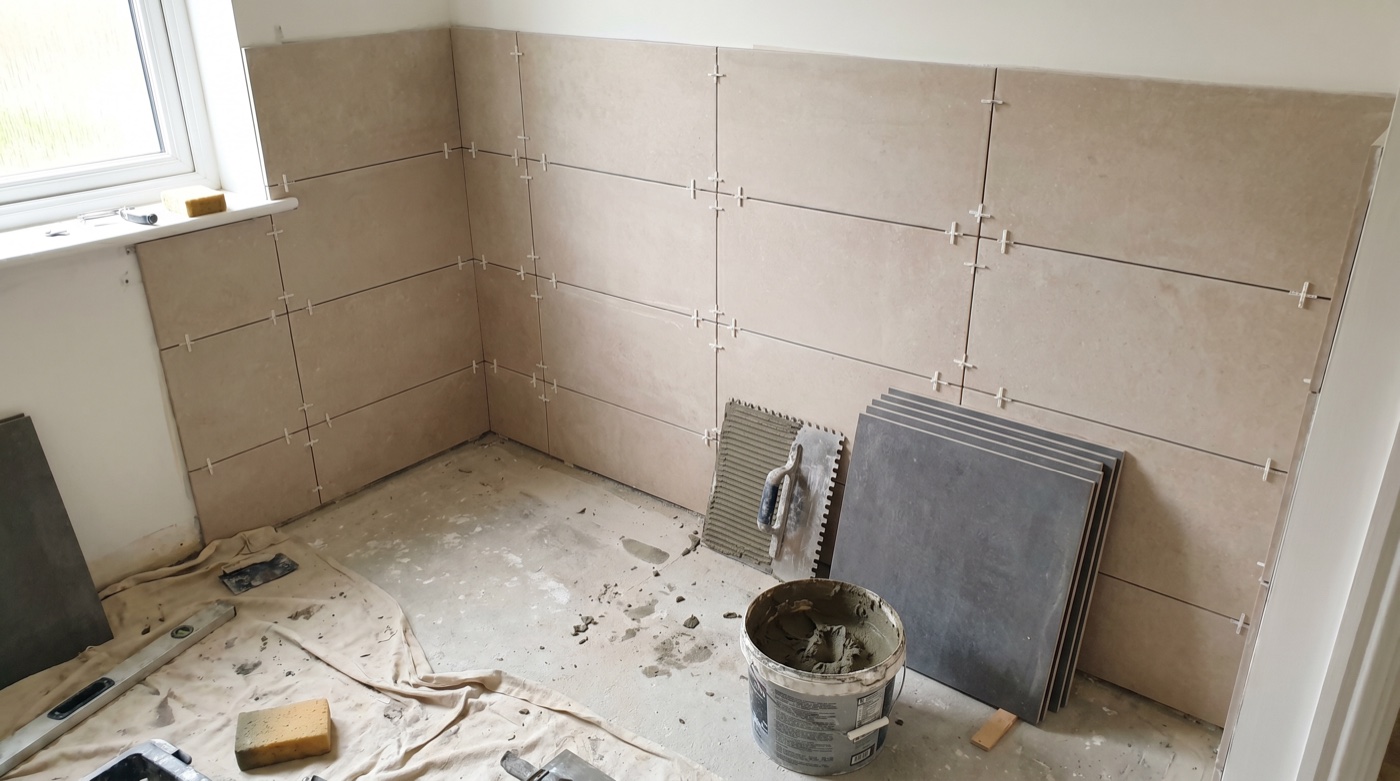
When our clients ask about the cost of tiling a bathroom in Cádiz, we explain that the final price depends on three factors: the cost of the materials, the complexity of the installation, and whether the existing tiles need to be removed. Stripping out old tiling, including rubble disposal, typically costs between €12 and €18/m². Surface preparation (levelling and priming) adds a further €5–8/m² where needed.
As for labour rates in the province of Cádiz in 2025–2026, standard ceramic installation runs between €18 and €30/m², while large-format or rectified porcelain (which demands greater precision) ranges from €28 to €45/m². On top of this, adhesive materials (tile cement, spacers and grout) typically add €3–6/m².
| Item | Price per m² (Cádiz, 2025–2026) |
|---|---|
| Removal of existing tiles + rubble disposal | €12–18/m² |
| Surface preparation (levelling) | €5–8/m² |
| Standard ceramic installation | €18–30/m² |
| Porcelain / large-format installation | €28–45/m² |
| Adhesive and grouting materials | €3–6/m² |
| Tiles (mid-range material) | €15–35/m² |
| Indicative total for full bathroom (floor + walls) | €55–120/m² |
For an average bathroom with around 12–15 m² of tileable surface, the total budget typically falls between €1,200 and €2,500 with mid-range materials and labour included. In kitchens, where tiling is usually confined to the working wall splashback (3–5 m²), the cost reduces to €400–800. These figures are indicative; at Reformas By Bianca we provide detailed, no-obligation quotes so you know exactly what to expect.
Common tiling mistakes and how to avoid them
The most common mistake is choosing a tile from a catalogue photograph without ever seeing the actual piece. Colours and textures can vary considerably between screen and reality, and between production batches. We always recommend requesting physical samples and viewing them in the natural light of your own bathroom or kitchen before confirming the order. In Cádiz, the natural light is intense and warm, and it can completely transform the way a grey or a white reads in a space.
Another classic error is not ordering enough material. The rule of thumb is to order 10–15% more than your calculated quantity to allow for cuts, breakages and a future reserve. If the tile is discontinued and you need to replace a piece in a few years' time, that stockpile is worth its weight in gold. We also see clients who choose floor tiles without checking the slip-resistance rating, and end up with a bathroom that becomes genuinely dangerous when wet.
- Not checking the anti-slip rating before buying bathroom floor tiles
- Choosing high-absorption ceramic for the inside of a shower enclosure
- Not accounting for grout joint width when planning the layout
- Mixing too many formats, colours or textures in a small space
- Forgetting that the grout colour affects the final result just as much as the tile itself
- Not ordering 10–15% extra material to cover cuts, wastage and a future reserve